Industrial IoT
Predictive Maintenance Sensors and Edge AI for a Steel Plant
- Reduction in Unplanned Downtime
- 78%
- Client-reported
- Fault-Classification Accuracy
- 94%
- Measured in pilot
- Sensor Nodes Across 3 Plants
- 500+
Core hardware
One engineering team from sensor and PCB hardware through firmware, BLE, Wi-Fi, LoRaWAN or cellular connectivity, secure device provisioning, OTA updates, cloud backends, dashboards and production handoff. We build the connected product and the systems required to operate it in the field.
Every project is quoted as a fixed-scope proposal within 3–5 business days of a discovery call. Discuss your product
Industrial IoT
Predictive Maintenance Sensors and Edge AI for a Steel Plant
Specifications
Capabilities
Our comprehensive IoT device engineering encompasses custom hardware design, firmware development, and multi-protocol connectivity optimization. We handle everything from sensor selection and PCB design to power management and enclosure engineering. Each device is designed for reliable operation in real-world conditions with OTA update capabilities and remote diagnostics.
We implement the optimal wireless protocol for your application: Wi-Fi 6 for high-bandwidth applications, BLE 5.x for proximity and wearables, LoRaWAN for long-range low-power deployments, NB-IoT/LTE-M for cellular coverage, Thread/Matter for smart home interoperability, and Zigbee for mesh networking. Protocol selection is optimized for range, power consumption, data rate, and cost.
Cloud backends on AWS IoT Core, Azure IoT Hub, or a self-managed MQTT broker (for example EMQX or HiveMQ) on Google Cloud or on-premise. We architect backends with time-series databases, real-time stream processing, RESTful APIs, and comprehensive device management, sized for the message rates and latency your application needs.
Security is embedded at every layer: hardware security modules (HSM) for key storage, secure boot with certificate verification, TLS 1.3 encrypted communication, mutual authentication, and zero-trust architecture. We follow OWASP IoT guidance and design to IEC 62443-4-2, ETSI EN 303 645 and EN 18031 (EU Radio Equipment Directive cybersecurity) requirements, with Cyber Resilience Act readiness planned per product; healthcare products are designed to support HIPAA Security Rule safeguards.
Transform raw IoT data into actionable insights with custom analytics platforms. We build real-time dashboards using Grafana, custom React applications, and mobile apps. Advanced features include anomaly detection using ML models, predictive maintenance algorithms, and automated alerting. Integration with business intelligence tools like PowerBI and Tableau is supported.
Process data at the edge to cut latency and the data sent to the cloud. Our edge solutions run on devices ranging from microcontrollers to industrial gateways. We implement LiteRT (TensorFlow Lite), Edge Impulse, and custom ML models for on-device inference.
Combine multiple sensor inputs for enhanced accuracy and reliability. Our sensor fusion algorithms integrate IMUs, environmental sensors, proximity sensors, and application-specific sensors into coherent data streams. Kalman filtering, complementary filters, and ML-based fusion techniques extract maximum value from your sensor array.
Create virtual representations of physical IoT systems for simulation, optimization, and predictive maintenance. Our digital twins synchronize in real-time with deployed devices, enabling what-if scenarios, performance optimization, and predictive failure analysis. Integration with SCADA systems and enterprise resource planning (ERP) solutions is supported.
Building on a specific platform? See how we design ESP32 Wi-Fi products and Nordic Bluetooth LE and cellular IoT devices, and how our IoT cloud backend development connects them to the cloud.
We select the protocol from the application requirements. Ranges are typical planning figures; the real range depends on the environment, antenna, transmit power and PHY, and is confirmed on the assembled device.
| Protocol | Range | Power | Data rate | Best for |
|---|---|---|---|---|
| Wi-Fi 6/6E | ~30–50 m indoors | High | High | Video, High-bandwidth |
| BLE 5.x | 10–50 m indoors (up to ~1 km LOS with Coded PHY) | Very Low | Medium | Wearables, Beacons |
| LoRaWAN | 2–5 km urban, 10–15+ km rural LOS | Very Low | Low | Agriculture, Utilities |
| NB-IoT | Cellular | Low | Low | Asset Tracking, Meters |
| LTE-M | Cellular | Medium | Medium | Fleet, Healthcare |
| Thread (Matter over Thread) | 10–30 m per hop, mesh | Low | Low | Smart Home |
Deciding between low-power WAN protocols? Read our LoRaWAN vs NB-IoT vs LTE-M comparison or the BLE vs Wi-Fi vs Thread vs Matter guide for short-range options.
Process
Requirements analysis, connectivity protocol and cloud platform selection, security architecture and threat modelling.
Deliverable: IoT architecture and device-to-cloud interface documentation
Hardware design and firmware, backend APIs and databases, mobile app and dashboards, data pipeline.
Deliverable: Device, firmware and cloud builds with a source and build handoff
Check installation, telemetry quality, power consumption and support procedures under real operating conditions.
Deliverable: Pilot acceptance results
Device provisioning and fleet management, performance monitoring, security updates and OTA rollouts.
Deliverable: Provisioning, update and rollback procedures
Engineering notes
IoT product development joins the device, connectivity, cloud and operating workflow. Begin with what happens at the installation site: available power, coverage, sensor data, permitted outages and the people responsible for maintenance. A prototype that sends telemetry is an early milestone in a deployable product.
Compare BLE, Wi-Fi, LoRaWAN and cellular options using payload size, reporting frequency, coverage, mobility and subscription or gateway costs. Validate the link at representative sites. Battery life depends on the complete duty cycle, including retries and poor coverage; the protocol name alone cannot predict years of operation.
Specify which functions must continue without the cloud, how data is buffered and how devices recover after reconnection. Assign ownership for device identity, provisioning, access control, updates and retirement. Define what happens when a credential expires, an update fails or a customer changes their network.
Use a pilot to check installation, telemetry quality, power consumption and support procedures under real operating conditions. Estimate device, gateway, connectivity and cloud costs separately. Expansion should follow agreed acceptance results, with alerts and rollback procedures in place.
Planning
Start with a non-confidential summary of your product and the milestone you need to reach next.
An IoT estimate needs a device-to-cloud scope: what the device measures or controls, where it operates, how it connects, and who maintains it after deployment. Define the next milestone before choosing hardware or a cloud platform.
Agree device and cloud responsibilities, interface documentation, source/build handoff, and deployment ownership. Define tests for data delivery, power consumption, loss of connectivity, update recovery, and access control under stated conditions. Price pilot deployment, external certification, connectivity subscriptions, cloud operation, and ongoing support separately.
Agree confidentiality arrangements before sharing proprietary design files.
EU and US market access: CE under RED with EN 18031 cybersecurity, the Cyber Resilience Act timeline, FCC Part 15 and IEC 62368-1 safety.
Proof
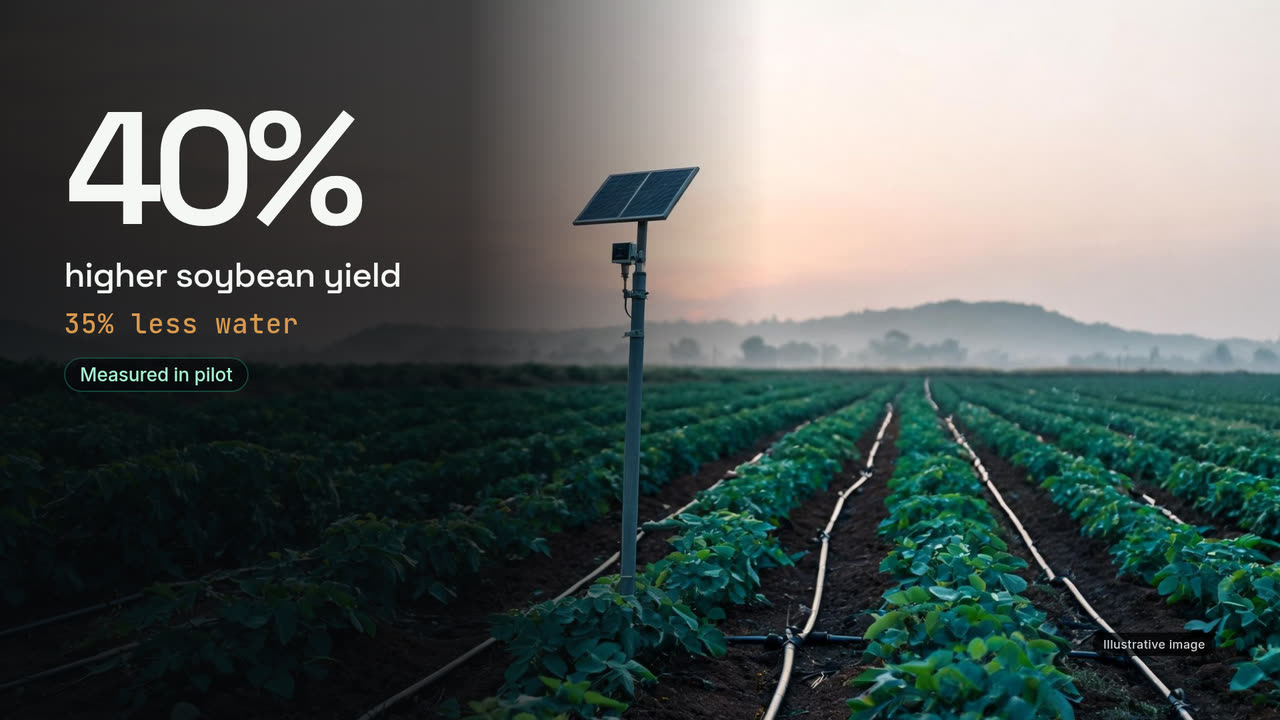
Solar LoRaWAN sensors for precision irrigation25 s · no sound
Industrial IoT
Steel manufacturer, India (3 plants)
Smart Agriculture
Agricultural cooperative, Maharashtra, India
Digital Twin
Commercial real estate developer
Battery-Free IoT
Public infrastructure authority
Multi-Connectivity Pet Tracker
European pet technology company
BLE Beacon RTLS
Asset-tracking client, Dubai, UAE
UWB Asset Tracker
Warehouse-technology company, Bangalore, India
ToF Tank Level Monitor
Industrial client, India
mmWave People-Counting Sensor
Smart-building and retail client, Dubai, UAE
Hotel Call-Button System
Hospitality client, Oman
Smart IV Infusion Pump
Medical-device company, India
Oral Screening Camera Probe
Medical-device client, India
FAQ
We implement a wide range of connectivity options: WiFi (802.11 b/g/n/ac/ax), Bluetooth/BLE 5.x, LoRaWAN for long-range low-power, NB-IoT/LTE-M for cellular IoT, Zigbee/Thread for mesh networks, MQTT/CoAP for application protocols, and custom RF solutions. Protocol selection is optimized based on range, power consumption, data rate, and deployment requirements.
Security is built into every layer: hardware security modules (HSM) for key storage, secure boot with code signing, encrypted communication (TLS 1.3), mutual authentication, secure OTA updates, tamper detection, and regular security audits. We follow OWASP IoT guidelines and can implement industry-specific security standards like IEC 62443 for industrial IoT.
We integrate connected devices with AWS IoT Core, Azure IoT Hub, or a self-managed MQTT broker (for example EMQX or HiveMQ) on Google Cloud or on-premise. Google Cloud IoT Core was retired on August 16, 2023, so a Google Cloud deployment needs its own device-connectivity layer. We scope device provisioning, data ingestion, dashboards, and bidirectional communication against the supported services and security requirements of the selected platform.
Edge computing processes data locally on the IoT device rather than sending everything to the cloud. Use edge computing when you need fast local responses (often milliseconds, measured on the target), have limited/expensive connectivity, process sensitive data requiring privacy, or need to reduce cloud costs. Our edge AI solutions can run machine learning models directly on embedded hardware.
We implement comprehensive device management including remote configuration, OTA firmware updates, health monitoring, predictive maintenance alerts, usage analytics, and remote diagnostics. Architectures are designed for staged, fleet-wide rollouts and load-tested to the agreed device count. Custom dashboards provide real-time visibility into fleet status and performance.
Battery life depends on the duty cycle, payload, link quality and cell. As planning targets: LoRaWAN nodes reporting a few times per hour can reach 5+ years on a lithium-thionyl chloride AA (ER14505) cell; BLE beacons 1–3 years on a CR2032 coin cell; Wi-Fi devices months rather than years. We measure the current profile of the assembled device before committing to a figure. Energy harvesting can remove battery replacement, but supercapacitors and rechargeable cells still age.
IoT (Internet of Things) development encompasses the design, implementation, and deployment of connected devices that collect, transmit, and process data. IoT development includes hardware design (sensors, connectivity modules), firmware development (communication protocols, security), cloud integration (data pipelines, analytics), and fleet management (OTA updates, monitoring).
Source: Industry definition. Related terms: MQTT, LoRaWAN, BLE, cloud platform.
Budgeting a connected product? Start with our IoT development cost guide.
Each project is quoted as a fixed-scope proposal: a statement of work with milestones, deliverables and pricing, sent within 3–5 business days of the discovery call. The price depends on the requirements, how mature the design is, technical complexity, the number of prototype iterations and the validation scope. Longer engagements can also run as a retainer or a hybrid of both. For budgeting before you contact us, our hardware development cost benchmarks and the PCB design, firmware and IoT cost guides give indicative ranges with their assumptions stated. They are planning ranges, not quotes.
It depends on the scope and on what already exists when we start. As planning ranges from our cost benchmarks: a single PCB layout takes 2–6 weeks per board and embedded firmware 4–16 weeks. A connected (IoT) product takes 3–12 months from concept to a production-ready design, and a regulated medical device 12–24 months to a 510(k) submission-ready package; from idea to mass production, a typical connected product takes 9–18 months. The proposal sets out a dated milestone plan, and you receive weekly progress updates during the project.
You do. Our contracts assign the intellectual property in the project work product (schematics, PCB design files, firmware source code and documentation) to you on payment, and we hand over the source files, not only fabrication outputs or compiled binaries. The exact terms are set out in the signed agreement for each engagement.
Yes. We sign a mutual NDA before any technical discussion of your project. Send your standard NDA or use ours; we return it signed within one business day.
Yes. We are based in Hyderabad, India, and work with product teams in India, the United States, the United Kingdom, Germany, Japan, Australia, the Middle East and other markets. Our office hours are 10:30–19:00 India Standard Time (UTC+5:30), Monday to Saturday, and we schedule design reviews across time zones, typically from US Pacific to Central European time. Japan is 3.5 hours ahead of India, so our first four hours overlap the Japanese afternoon. Prototypes and documentation ship by international courier such as DHL or FedEx. Our hardware outsourcing guide covers what to agree before an international project starts.
Yes. We prepare the manufacturing release package — fabrication and assembly drawings, the BOM with approved manufacturers, programming files and test specifications — and hand it over to the contract manufacturer (EMS) you choose. If you have not chosen one, we help you evaluate candidates through technical capability assessments and a pilot build. See manufacturing support.
No. Rapid Circuitry does not hold ISO 9001, ISO 13485 or other certificates. Our processes are aligned with ISO 9001:2015, and we design products to the requirements of the standards that apply to them — for example IEC 60601-1 and IEC 62304 for medical devices (with design documentation structured so your ISO 13485 quality system can absorb it) and IEC 61000 for EMC — and we specify IPC-A-610 workmanship classes for assembly. We prepare the product and its documentation for certification testing at accredited laboratories; the certificate or approval is issued for your product by the laboratory, notified body or regulator.
A short, non-confidential description of the product and what it must do (sensors, connectivity, on-device processing), the target production volume and unit cost, the markets and regulations it must meet (for example FDA, CE or FCC), your timeline, and what already exists: a concept, a proof of concept, schematics, PCB files or firmware. After the NDA, the next step is a 30-minute discovery call with the engineers who would work on the project, followed by the fixed-scope proposal. Send a project brief to begin.
Explore
System architecture, MCU/SoC selection, schematic and PCB design, board bring-up, validation and manufacturing handoff.
Device-to-cloud backends: provisioning, MQTT and API ingestion, time-series data, OTA coordination and fleet monitoring.
On-device inference: feasibility on your target hardware, model porting and quantisation, and integration with the firmware.