Infrastructure / Civil Engineering / Smart Cities
Battery-free IoT: Energy-harvesting sensor nodes for structural health monitoring
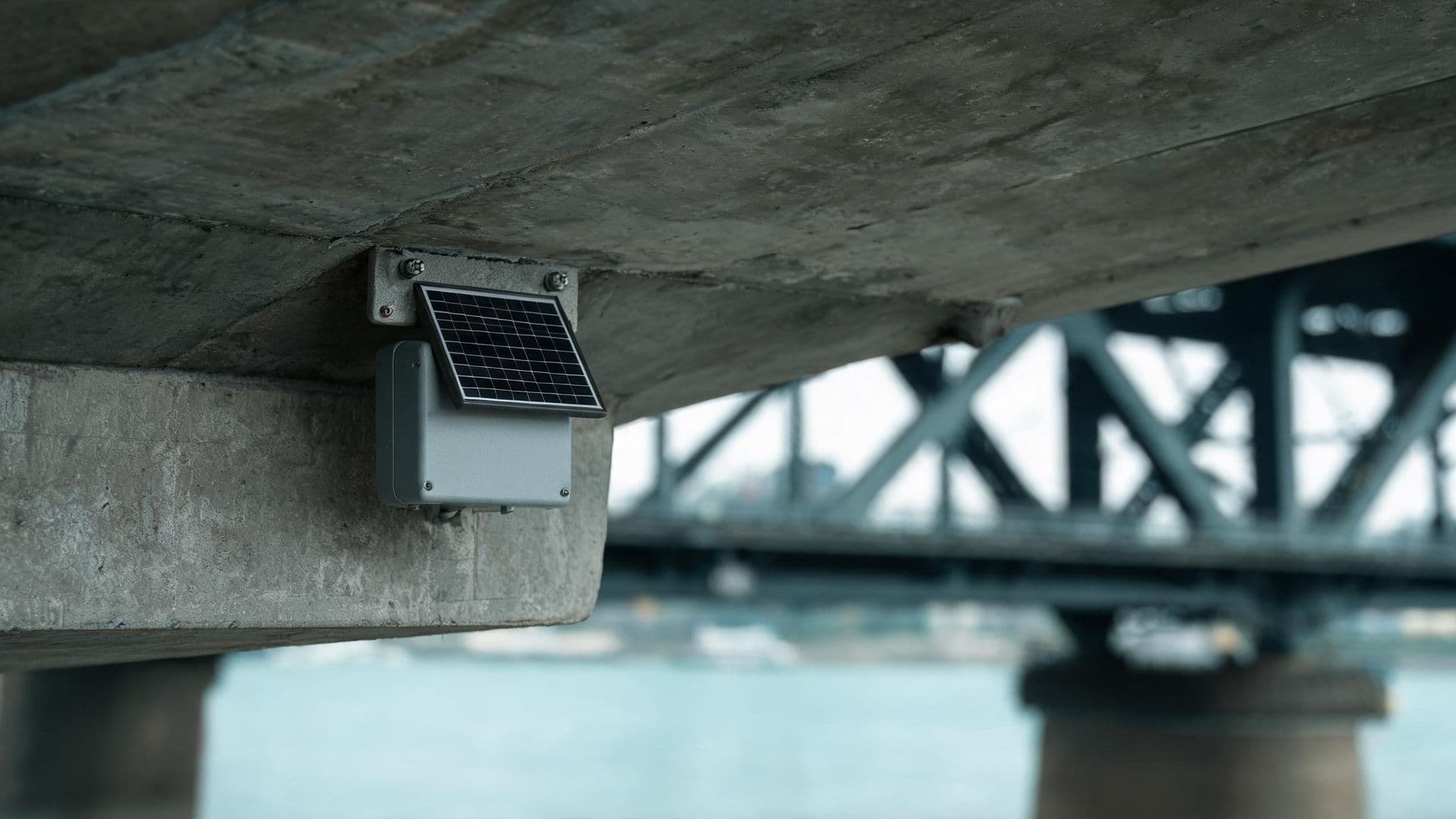
Design of battery-free structural-health sensor nodes that run on vibration, thermal and solar energy harvesting with supercapacitor storage, validated in a 200-sensor pilot on 3 bridges before a wider rollout. The 20-year maintenance-free life is a design target.
What we did: We designed the energy-harvesting sensor node (harvesting front end, supercapacitor power management, sensing and wake-up radio), its ultra-low-power firmware, the solar gateways and the analytics platform.
Public infrastructure authority20 months
Published Last reviewed:
 Illustrative image
The challenge
A national infrastructure authority responsible for thousands of kilometers of highways, hundreds of bridges, and critical tunnels needed a scalable structural health monitoring solution that could operate for decades without battery replacements or maintenance in harsh outdoor environments.
Aging infrastructure
Over 40% of bridges and tunnels were over 50 years old, with unknown structural degradation. Manual inspections occurred only annually, potentially missing developing issues between inspection cycles.
Maintenance impossibility
Traditional battery-powered sensors required replacement every 2-5 years. With structures spanning hundreds of kilometers in remote areas, battery replacement was logistically impossible and prohibitively expensive.
Environmental extremes
Sensors needed to operate in temperatures from -30°C to +60°C, 100% humidity, vibration from heavy traffic, and exposure to road salt, de-icing chemicals, and UV radiation.
Connectivity gaps
Many structures were in areas with no cellular coverage. Running power or communication cables to sensor locations was cost-prohibitive and structurally invasive.
Data overload risk
Previous sensor trials generated so much raw data that analysis became impractical. The authority needed actionable insights, not terabytes of unprocessed data.
Impact figures describe the situation before the project, as the client reported it to us; we did not measure them.
Our solution
We engineered a battery-free structural health monitoring system using multi-source energy harvesting, ultra-low-power electronics, and anomaly detection that turns raw sensor data into maintenance alerts.
System architecture
Tiered architecture with energy-autonomous sensor nodes, solar-powered edge gateways, and cloud-based AI analytics for predictive maintenance.
Energy harvesting sensor nodes
- Piezoelectric vibration energy harvesting from traffic
- Thermoelectric harvesting from temperature differentials
- Miniature solar cells for ambient light harvesting
- RF energy harvesting for gateway-powered wake-up
- Supercapacitor energy storage (no batteries)
Sensing capabilities
- MEMS accelerometers for vibration analysis
- Strain gauges for stress monitoring
- Tilt sensors for displacement detection
- Corrosion sensors for reinforcement degradation
- Temperature and humidity for environmental context
Edge gateway layer
- Solar-powered aggregation gateways
- Wake-up radio for on-demand sensor interrogation
- LTE-M/NB-IoT backhaul (LoRaWAN where there is no cellular coverage)
- Edge AI for initial anomaly filtering
- 30-day local data buffering
Cloud analytics platform
- Digital twin integration with BIM models
- ML-based structural health scoring
- Predictive maintenance scheduling
- Regulatory reporting automation
- Mobile app for field inspectors
Energy harvesting sensor node design
- Controller
- Ultra-low-power controller with sub-threshold operation
- Power Consumption
- < 10 µW average at one strain/vibration snapshot per hour; 100 nW sleep (design target)
- Energy Harvesting
- Piezo + TEG + Solar (1-100µW)
- Storage
- 100mF supercapacitor (no battery)
- Radio
- Wake-up receiver + IR-UWB burst transmitter to a gateway on the same span
- Sensors
- 3-axis accel, strain, temp, humidity, corrosion
- Enclosure
- IP68, -40°C to +85°C, UV resistant
- Lifespan
- 20 years with no maintenance (design target)
Ultra-low-power firmware
- Event-driven architecture with aggressive sleep modes
- On-device FFT and feature extraction
- Adaptive sampling based on harvested energy budget
- Intermittent computing with state checkpointing
- Self-calibration and health monitoring
- Compressed data transmission protocol
- Time synchronization for distributed sensing
Structural health AI analytics
The analytics platform learns the vibration 'fingerprint' of each structure and flags subtle changes that can indicate developing problems. The figures below are design targets; they have not been validated over a structure's service life.
Modal analysis AI
Variational autoencoder for frequency analysis
Detects 0.5% changes in natural frequency
Design targetAnomaly detection
Isolation Forest + deep learning ensemble
94% true positive, <2% false alarm rate
Design targetRemaining useful life
Physics-informed neural network
6-month prediction with 85% accuracy
Design targetLoad estimation
CNN on vibration signatures
±5% traffic load estimation
Design targetCorrosion progression
Time-series forecasting model
Corrosion rate prediction ±10%
Design targetImplementation timeline
Phase 1: Technology development
24 weeks- Energy harvesting optimization for local conditions
- Ultra-low-power node electronics design
- Sensor node prototyping and validation
- Communication protocol development
Phase 2: Pilot deployment
16 weeks- 200-sensor pilot on 3 bridges
- Baseline data collection and model training
- Gateway and platform development
- Performance validation through load testing
Phase 3: Production readiness
20 weeks- Node production for the wider rollout
- Quality assurance and reliability testing
- Installation methodology refinement
- Training for installation teams
Phase 4: Rollout support
24 weeks- Rollout to further structures
- AI model refinement per structure type
- Integration with authority systems
- Operations handover
Results & impact
The 200-sensor pilot on 3 bridges was used for baseline data collection, model training and performance validation through load testing before the wider rollout. Long-term reliability, the 20-year design life and failure-prediction horizons are design targets; inspection-cost and safety outcomes are not published.
How to read the labels: Design target = an engineering target, not a field measurement; Client-reported baseline = the client's own figure for the situation before the project; we did not measure it. Figures without a label are specifications or project scope.
Energy autonomy
Battery-free
Piezo, thermoelectric and solar harvesting into a supercapacitor
Average node power
Design target< 10 µW
At one strain/vibration snapshot per hour; 100 nW in sleep
Design life
Design target20 years
No battery replacement or maintenance
Technologies used
- Ultra-Low-Power Controller
- Piezoelectric Harvesting
- TEG
- Supercapacitors
- IR-UWB
- Wake-up Radio
- LTE-M/NB-IoT
- LoRaWAN
- TensorFlow
- Azure IoT
- Autodesk BIM 360
- React
- Python
Related case studies
Manufacturing / Heavy Industry
Industrial IoT: Predictive maintenance sensors and edge AI for a steel plant
Agriculture / AgriTech