Agriculture / AgriTech
Smart agriculture: Solar-powered LoRaWAN sensor network for precision irrigation
Design of a solar-powered precision-agriculture IoT system — soil and weather sensor nodes, LoRaWAN gateways, irrigation models and a multilingual farmer app — piloted with 100 nodes on 200 acres, where the pilot measured 40% higher soybean yield and 35% lower water use, before a cooperative-wide rollout.
What we did: We designed the solar sensor-node hardware and firmware, the gateway and cloud setup, the irrigation and fertiliser models, and the Marathi/Hindi/English Android app.
Agricultural cooperative, Maharashtra, India10 months
Published Last reviewed:
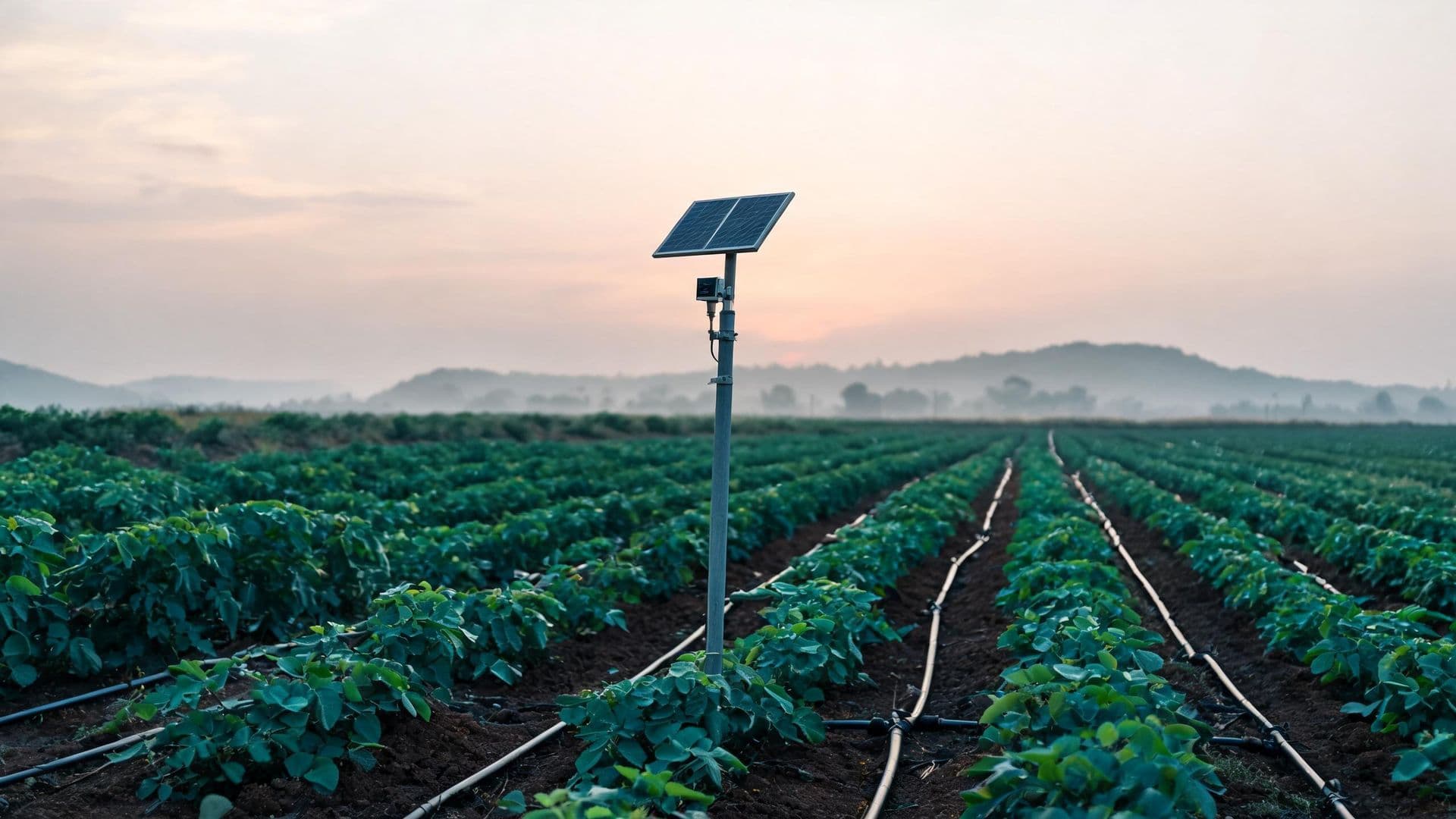 Illustrative image
The challenge
An agricultural cooperative in Maharashtra managing 5,000 acres across 200+ farms needed a precision agriculture solution to optimize water usage, improve crop yields, and provide actionable insights to farmers with varying levels of technical literacy.
Water scarcity
The region faced severe groundwater stress, and traditional flood irrigation wasted a large share of the water applied.
Inconsistent yields
Crop yields varied by 50% across similar plots due to lack of data-driven decision making. Farmers relied on intuition and traditional practices.
No connectivity
Most farms had no cellular coverage or reliable power supply. Any IoT solution needed to work completely off-grid with long-range communication.
Diverse user base
Farmers ranged from tech-savvy young graduates to elderly farmers with no smartphone experience. The system needed to serve all user types.
Impact figures describe the situation before the project, as the client reported it to us; we did not measure them.
Our solution
We designed a precision agriculture system including solar-powered sensor nodes, LoRaWAN networking, data-driven irrigation and fertiliser recommendations, and a multilingual mobile app with voice interface for farmers.
System architecture
Fully off-grid architecture designed for remote agricultural environments with no existing infrastructure.
Field sensor layer
- Soil moisture sensors at multiple depths
- Soil NPK nutrient sensors
- Weather stations (temperature, humidity, rainfall, wind)
- Leaf wetness and canopy sensors
- Water flow meters for irrigation monitoring
Communication layer
- LoRaWAN network, IN865 band (up to 15 km line of sight)
- Solar-powered gateway nodes
- Satellite backhaul for remote areas
- Local data buffering for connectivity gaps
Intelligence layer
- Crop-specific ML models for irrigation scheduling
- Weather forecasting integration
- Pest and disease risk prediction
- Yield estimation models
- Fertilizer recommendation engine
Farmer interface
- Android app in Marathi, Hindi, English
- Voice-based interaction for farmers who prefer not to read
- SMS alerts for critical events
- WhatsApp integration for recommendations
- Community dashboard for cooperative
Custom hardware design
- MCU
- STM32L072 (ultra-low power)
- Radio
- Semtech SX1262 (LoRaWAN, IN865: 865–867 MHz)
- Solar Panel
- 2W polycrystalline
- Battery
- 3.2 V 6000 mAh LiFePO4
- Sensors
- Capacitive soil moisture, I2C NPK
- Enclosure
- IP66 UV-resistant ABS
- Operating Life
- 5+ years maintenance-free (design target)
Firmware features
- Adaptive sampling based on crop growth stage
- LoRaWAN Class A networking
- Local data storage for 30 days offline operation
- Solar power management with MPPT
- Self-diagnostics and remote health monitoring
- OTA firmware updates over LoRa
AI-powered recommendations
We developed crop-specific ML models trained on local agricultural data to provide actionable recommendations. Irrigation and yield-estimation accuracy were measured on the pilot crop cycle; the pest-outbreak figure is a design target, because one season on 200 acres has too few outbreaks to measure it.
Irrigation scheduling
Ensemble (Random Forest + LSTM)
92% water need prediction
Measured in pilotPest risk prediction
Gradient Boosting classifier
87% pest outbreak prediction
Design targetYield estimation
CNN on satellite + field data
±8% yield prediction
Measured in pilotFertilizer recommendation
Rule-based + ML hybrid
Crop-specific NPK optimization
Implementation timeline
Phase 1: Research & design
8 weeks- Field visits and farmer interviews
- Soil type and crop analysis
- Network coverage survey
- Hardware and software architecture
Phase 2: Pilot development
10 weeks- 100-node pilot deployment (200 acres)
- Gateway and cloud infrastructure setup
- Mobile app development
- Initial ML model training
Phase 3: Pilot validation
16 weeks- One full crop cycle monitoring
- Model refinement with local data
- Farmer feedback incorporation
- Reliability and durability testing
Phase 4: Scale deployment
12 weeks- Sensor node production for the cooperative-wide rollout
- Farmer training programs
- Cooperative dashboard launch
Results & impact
These results were measured on the 200-acre pilot (100 nodes) over one crop cycle. Financial, income and return-on-investment estimates are not published.
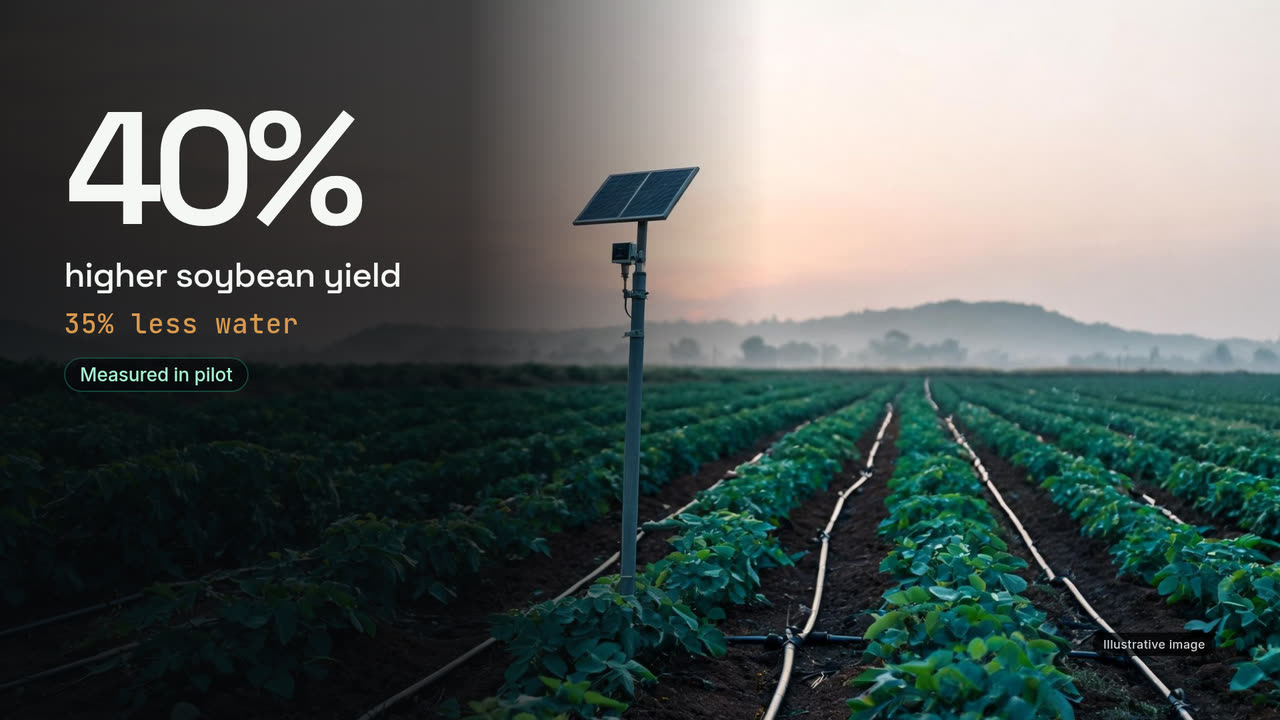
Solar LoRaWAN sensors for precision irrigation25 s · no sound
Video text
- 40% higher soybean yield. 35% less water. (Measured in pilot.)
- Case study · Agricultural cooperative, Maharashtra. No cellular coverage. No reliable power. Across most farms of a 5,000-acre cooperative.
- An off-grid sensor node. IP66 enclosure. 30-day local storage. Power: Solar panel 2 W → MPPT charger → LiFePO₄ 3.2 V · 6000 mAh → Regulator. Data: NPK sensor (I²C) and capacitive soil moisture → STM32L072, LoRaWAN Class A → SPI → SX1262, LoRa · IN865.
- Pilot: 100 nodes · 200 acres · one crop cycle. Farmer app in Marathi, Hindi and English.
- 40% higher soybean yield. 35% less water. 25% lower fertiliser cost per acre. (Measured in pilot.) Pilot plots, one crop cycle.
- Solar LoRaWAN sensors for precision irrigation. Rapid Circuitry. Discuss your product → rapidcircuitry.com/contact. Reply within one business day · Mutual NDA on request.
- The photo is an illustrative image.
How to read the labels: Measured in pilot = measured during the project's pilot deployment; Design target = an engineering target, not a field measurement; Client-reported baseline = the client's own figure for the situation before the project; we did not measure it. Figures without a label are specifications or project scope.
Crop yield increase
Measured in pilot40%
Higher soybean yield on the pilot plots
Water consumption
Measured in pilot35%
Lower water use on the pilot plots
Fertilizer usage
Measured in pilotTechnologies used
- STM32L072
- LoRaWAN
- SX1262
- Solar MPPT
- TensorFlow
- React Native
- AWS IoT
- PostgreSQL
- TimescaleDB
- Python
Related case studies
Manufacturing / Heavy Industry
Industrial IoT: Predictive maintenance sensors and edge AI for a steel plant
Infrastructure / Civil Engineering / Smart Cities