IEC 62443
Industrial cybersecurity
Security at every layer for industrial IoT: secure boot, TLS-encrypted communication and mutual authentication, following IEC 62443-4-1 (secure development) and IEC 62443-4-2 (component requirements).
Industries
We design industrial IoT hardware, firmware and data pipelines: condition-monitoring sensors, edge gateways (OPC UA, Modbus, MQTT), asset tracking (BLE, UWB) and rugged controllers, designed to IEC 62443 and, where required, IEC 61508 and ATEX/IECEx requirements.
What we build
Industry 4.0 systems with automation, real-time production monitoring, and digital process control that help raise throughput and reduce quality defects.
AI-powered condition monitoring that analyzes vibration, temperature, and operational patterns to predict equipment failures before they occur and reduce unplanned downtime.
Secure, scalable industrial communication networks with OPC UA, MQTT, and Modbus integration, enabling data flow between machines, sensors, and enterprise systems.
Real-time production intelligence dashboards that turn operational data into insights for OEE optimization, quality management, and production planning with customizable KPIs.
Virtual replicas of physical manufacturing systems for simulation, optimization, and validation of process changes before implementation, reducing implementation risk.
Energy management systems that identify consumption patterns, detect inefficiencies, and automate load balancing to reduce energy costs across manufacturing operations.
Modern, intuitive control systems with mobile-responsive interfaces that give operators real-time visibility and control over industrial processes from any location.
Ruggedized edge computing platforms that process data locally for fast response in critical applications while minimizing bandwidth requirements and cloud computing costs.
Applications
Standards
Industrial cybersecurity
Security at every layer for industrial IoT: secure boot, TLS-encrypted communication and mutual authentication, following IEC 62443-4-1 (secure development) and IEC 62443-4-2 (component requirements).
Functional safety
Hardware and software designed to IEC 61508 requirements for the target SIL, with the safety case prepared for your independent functional-safety assessor.
Hazardous environments
Electronics designed to the intrinsic-safety requirements of IEC 60079-11 and prepared for ATEX/IECEx assessment by a notified body or IECEx certification body, with wide operating-temperature ranges.
Industrial protocols
Integration between machines, sensors and enterprise systems over OPC UA, MQTT and Modbus.
How we work
Requirements analysis, connectivity protocol and cloud platform selection, security architecture and threat modelling.
Hardware design and firmware, backend APIs and databases, dashboards and the data pipeline.
Installation, telemetry quality, power consumption and support procedures checked under real operating conditions.
Device provisioning and fleet management, performance monitoring, security updates and OTA rollouts.
Proof
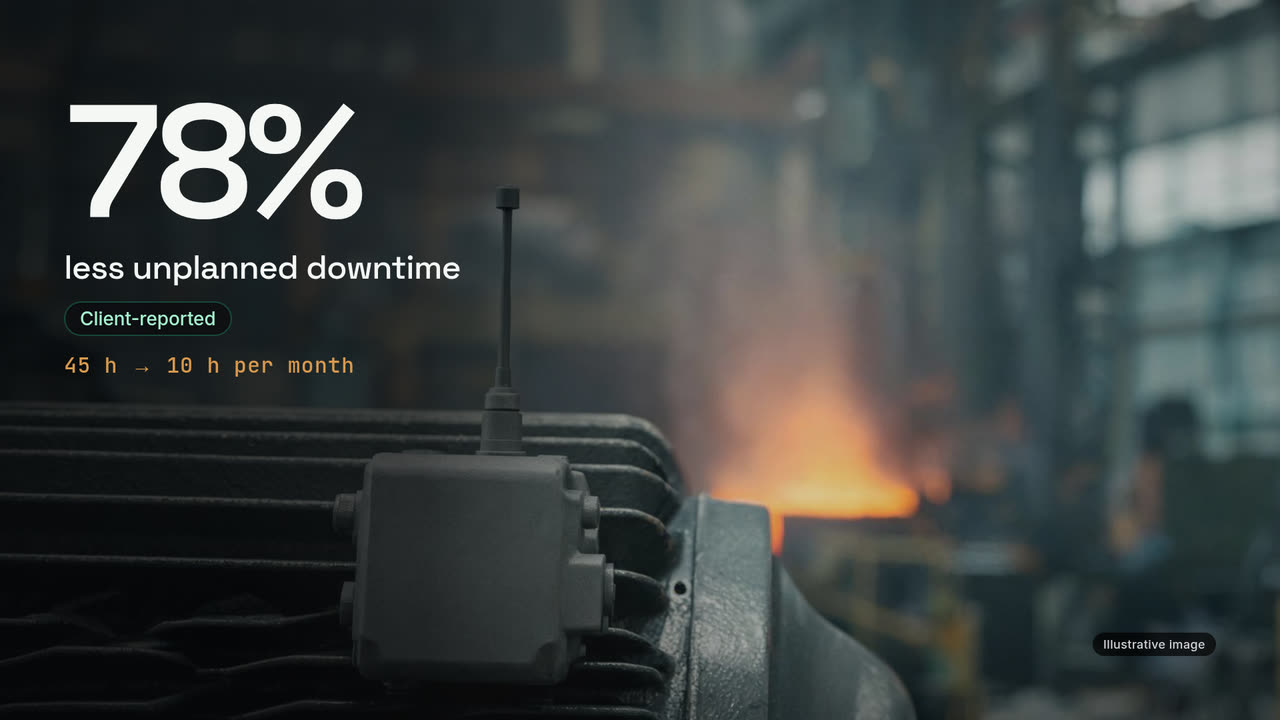
Predictive maintenance for a steel plant23 s · no sound
Industrial IoT
Steel manufacturer, India (3 plants)
Edge AI Robotics
E-commerce logistics provider
Robotic Arm Controller Board
Robotics evaluation-board project
BLE Beacon RTLS
Asset-tracking client, Dubai, UAE
UWB Asset Tracker
Warehouse-technology company, Bangalore, India
ToF Tank Level Monitor
Industrial client, India
FAQ
We implement the common industrial protocols: Modbus RTU/TCP, Profinet, EtherNet/IP, OPC UA, CAN/CANopen, HART, BACnet for building automation, and custom protocols. Our gateway solutions can bridge legacy equipment to modern IoT platforms, enabling digital transformation without replacing existing infrastructure.
We design electronics to the intrinsic-safety requirements of IEC 60079-11 (Ex ia/ib/ic) for the target zone, including energy limiting, component derating and segregation, and prepare the documentation for ATEX/IECEx assessment by a notified body or IECEx certification body. Flameproof (Ex d) and pressurised (Ex p) enclosures are specified with an enclosure partner.
Yes, our edge AI solutions enable predictive maintenance through vibration analysis, thermal monitoring, current signature analysis, and acoustic emission detection. Machine learning models run locally to detect anomalies and predict failures before they occur. Integration with CMMS/EAM systems enables automated work order generation.
Each project is quoted as a fixed-scope proposal: a statement of work with milestones, deliverables and pricing, sent within 3–5 business days of the discovery call. The price depends on the requirements, how mature the design is, technical complexity, the number of prototype iterations and the validation scope. Longer engagements can also run as a retainer or a hybrid of both. For budgeting before you contact us, our hardware development cost benchmarks and the PCB design, firmware and IoT cost guides give indicative ranges with their assumptions stated. They are planning ranges, not quotes.
It depends on the scope and on what already exists when we start. As planning ranges from our cost benchmarks: a single PCB layout takes 2–6 weeks per board and embedded firmware 4–16 weeks. A connected (IoT) product takes 3–12 months from concept to a production-ready design, and a regulated medical device 12–24 months to a 510(k) submission-ready package; from idea to mass production, a typical connected product takes 9–18 months. The proposal sets out a dated milestone plan, and you receive weekly progress updates during the project.
You do. Our contracts assign the intellectual property in the project work product (schematics, PCB design files, firmware source code and documentation) to you on payment, and we hand over the source files, not only fabrication outputs or compiled binaries. The exact terms are set out in the signed agreement for each engagement.
Yes. We sign a mutual NDA before any technical discussion of your project. Send your standard NDA or use ours; we return it signed within one business day.
Yes. We are based in Hyderabad, India, and work with product teams in India, the United States, the United Kingdom, Germany, Japan, Australia, the Middle East and other markets. Our office hours are 10:30–19:00 India Standard Time (UTC+5:30), Monday to Saturday, and we schedule design reviews across time zones, typically from US Pacific to Central European time. Japan is 3.5 hours ahead of India, so our first four hours overlap the Japanese afternoon. Prototypes and documentation ship by international courier such as DHL or FedEx. Our hardware outsourcing guide covers what to agree before an international project starts.
Yes. We prepare the manufacturing release package — fabrication and assembly drawings, the BOM with approved manufacturers, programming files and test specifications — and hand it over to the contract manufacturer (EMS) you choose. If you have not chosen one, we help you evaluate candidates through technical capability assessments and a pilot build. See manufacturing support.
No. Rapid Circuitry does not hold ISO 9001, ISO 13485 or other certificates. Our processes are aligned with ISO 9001:2015, and we design products to the requirements of the standards that apply to them — for example IEC 60601-1 and IEC 62304 for medical devices (with design documentation structured so your ISO 13485 quality system can absorb it) and IEC 61000 for EMC — and we specify IPC-A-610 workmanship classes for assembly. We prepare the product and its documentation for certification testing at accredited laboratories; the certificate or approval is issued for your product by the laboratory, notified body or regulator.
A short, non-confidential description of the product and what it must do (sensors, connectivity, on-device processing), the target production volume and unit cost, the markets and regulations it must meet (for example FDA, CE or FCC), your timeline, and what already exists: a concept, a proof of concept, schematics, PCB files or firmware. After the NDA, the next step is a 30-minute discovery call with the engineers who would work on the project, followed by the fixed-scope proposal. Send a project brief to begin.
Explore