Manufacturing / Heavy Industry
Industrial IoT: Predictive maintenance sensors and edge AI for a steel plant
Rapid Circuitry designed the wireless vibration-sensor nodes, edge-AI gateways and cloud dashboard for a steel manufacturer's predictive-maintenance system in India. After plant-wide deployment the client measured a 78% reduction in unplanned downtime.
What we did: We designed the sensor-node hardware and firmware, the STM32MP1 edge gateways with on-device inference, the ML models and the cloud dashboard, with node manufacturing through a partner.
Steel manufacturer, India (3 plants)8 months
Published Last reviewed:
 Illustrative image
The challenge
A steel manufacturer with 3 plants in India was experiencing significant losses due to unexpected equipment failures. Their existing maintenance approach was purely reactive, leading to costly unplanned shutdowns.
Unplanned downtime
Average of 45 hours per month of unplanned equipment downtime across critical machinery including rolling mills, compressors, and conveyor systems.
Reactive maintenance
Maintenance team could only respond after failures occurred, leading to cascading equipment damage and extended repair times.
No visibility
Plant managers had no real-time insight into equipment health, relying on periodic manual inspections that missed developing faults.
Safety concerns
Unexpected equipment failures posed safety risks to workers near rolling mills, compressors and conveyors.
Impact figures describe the situation before the project, as the client reported it to us; we did not measure them.
Our solution
We designed an Industrial IoT predictive maintenance system combining ruggedized wireless sensor nodes, edge AI processing on plant gateways, and a cloud-based analytics dashboard.
System architecture
Three-tier architecture optimized for industrial environments with unreliable connectivity and harsh conditions.
Sensor layer
- Custom triaxial MEMS accelerometer nodes
- Temperature and humidity sensors
- Current monitoring for motor loads
- IP67-rated enclosures for harsh environments
Edge layer
- STM32MP1-based edge gateways
- On-device ML inference (TensorFlow Lite)
- Local data buffering for connectivity gaps
- Industrial Ethernet and WiFi connectivity
Cloud layer
- AWS IoT Core for device management
- Time-series database (InfluxDB)
- Custom ML models for failure prediction
- Real-time dashboard and alerting
Custom hardware design
- Sensor Node MCU
- STM32L4 (ultra-low power)
- Accelerometer
- ADXL355 (low noise, 4 kHz ODR, ≈1 kHz bandwidth)
- Wireless
- LoRaWAN, IN865 band (865–867 MHz), 1 km+ in-plant
- Battery Life
- 5+ years on lithium thionyl chloride (design target)
- Operating Temp
- -40°C to +85°C
- Protection
- IP67 enclosure, designed to IEC 60079 Zone 2 requirements (PESO approval route in India)
Firmware features
- Time-synchronized vibration sampling across nodes
- On-device FFT and RMS calculation
- Adaptive sampling based on detected anomalies
- OTA firmware updates over LoRa
- Self-diagnostics and health reporting
Edge AI implementation
We deployed custom ML models at the edge gateway for real-time inference without cloud dependency. Detection and classification accuracy were measured on data from the 10-node pilot; the RUL figure is a design target.
Vibration anomaly detection
Autoencoder neural network
96% anomaly detection rate
Measured in pilot< 50ms inference time
Failure classification
Random Forest classifier
94% classification accuracy
Measured in pilotRemaining useful life (RUL)
LSTM neural network
±15% RUL estimation
Design targetImplementation timeline
Phase 1: Discovery & design
6 weeks- Plant audit and critical equipment identification
- Sensor placement optimization
- Network architecture design
- Hardware and firmware design
Phase 2: Prototype & validation
8 weeks- 10-node pilot deployment
- Data collection and ML model training
- Edge gateway development
- Cloud platform development
Phase 3: Full deployment
12 weeks- 500+ sensor nodes built through a manufacturing partner
- Plant-wide installation
- SAP integration
- Operator training
Phase 4: Optimization
6 weeks- ML model refinement with production data
- Alert threshold optimization
- Dashboard customization
- Handover and documentation
Results & impact
The client measured the downtime and MTBF figures after plant-wide deployment, against its own pre-project baseline; the length of that measurement window is not published. Model accuracy was measured on pilot data. Financial and return-on-investment estimates are not published.
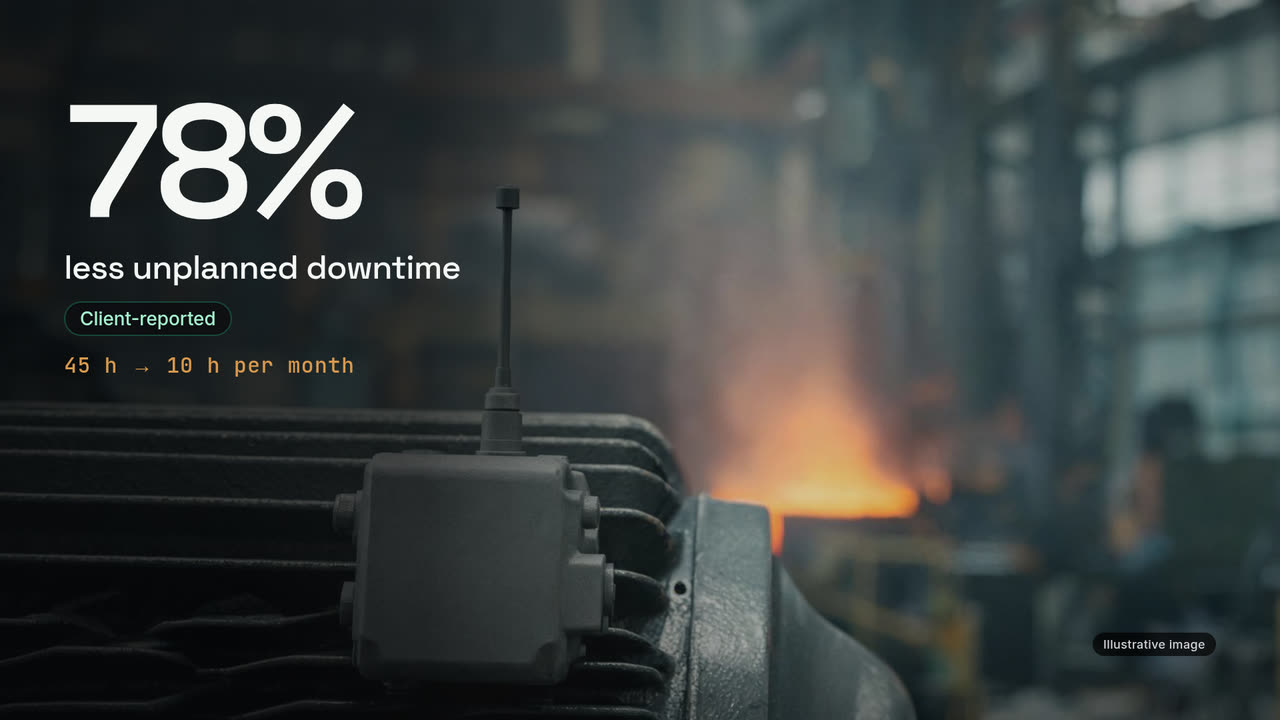
Predictive maintenance for a steel plant23 s · no sound
Video text
- 78% less unplanned downtime (Client-reported). 45 h → 10 h per month.
- Case study · Industrial IoT. A steel manufacturer, 3 plants in India. Maintenance was purely reactive.
- We designed the nodes, gateways, models and dashboard. Sensor node: STM32L4 · ADXL355, LoRa radio. LoRaWAN · IN865 link to the edge gateway: STM32MP1 · TensorFlow Lite, LoRaWAN gateway. Ethernet / Wi-Fi link to the cloud: AWS IoT Core · Grafana.
- 10-node pilot → 500+ nodes across 3 plants. 94% fault-classification accuracy (Measured in pilot). Bearing wear · imbalance · misalignment · looseness.
- Predictive maintenance for a steel plant. Rapid Circuitry. Discuss your product → rapidcircuitry.com/contact. Reply within one business day · Mutual NDA on request.
- The photo is an illustrative image.
How to read the labels: Client-reported = measured and reported by the client's own team; we did not measure it; Measured in pilot = measured during the project's pilot deployment; Design target = an engineering target, not a field measurement; Client-reported baseline = the client's own figure for the situation before the project; we did not measure it. Figures without a label are specifications or project scope.
Unplanned downtime reduction
Client-reportedMean time between failures
Client-reportedFault-classification accuracy
Measured in pilot94%
Bearing wear, imbalance, misalignment, looseness
Technologies used
- STM32L4
- STM32MP1
- LoRaWAN
- TensorFlow Lite
- AWS IoT Core
- InfluxDB
- Grafana
- React
- Python
- SAP PM Integration
Related case studies
Agriculture / AgriTech
Smart agriculture: Solar-powered LoRaWAN sensor network for precision irrigation
Infrastructure / Civil Engineering / Smart Cities