Logistics / Warehousing / Robotics
Edge AI robotics: Compute, perception and on-device navigation for warehouse AMRs
Rapid Circuitry designed the compute and perception electronics and the on-device ML navigation software for an autonomous mobile robot (AMR) platform, validated in a 20-robot pilot zone of an e-commerce fulfilment centre before the full-warehouse rollout. Fleet-level throughput results are the client's and are not published here.
What we did: We designed the robot compute board (Cortex-A78 SoC with a 4 TOPS NPU), integrated the LiDAR, depth-camera and IMU sensors, and developed the ROS 2 navigation stack, on-device ML models and fleet-coordination software.
E-commerce logistics provider16 months
Published Last reviewed:
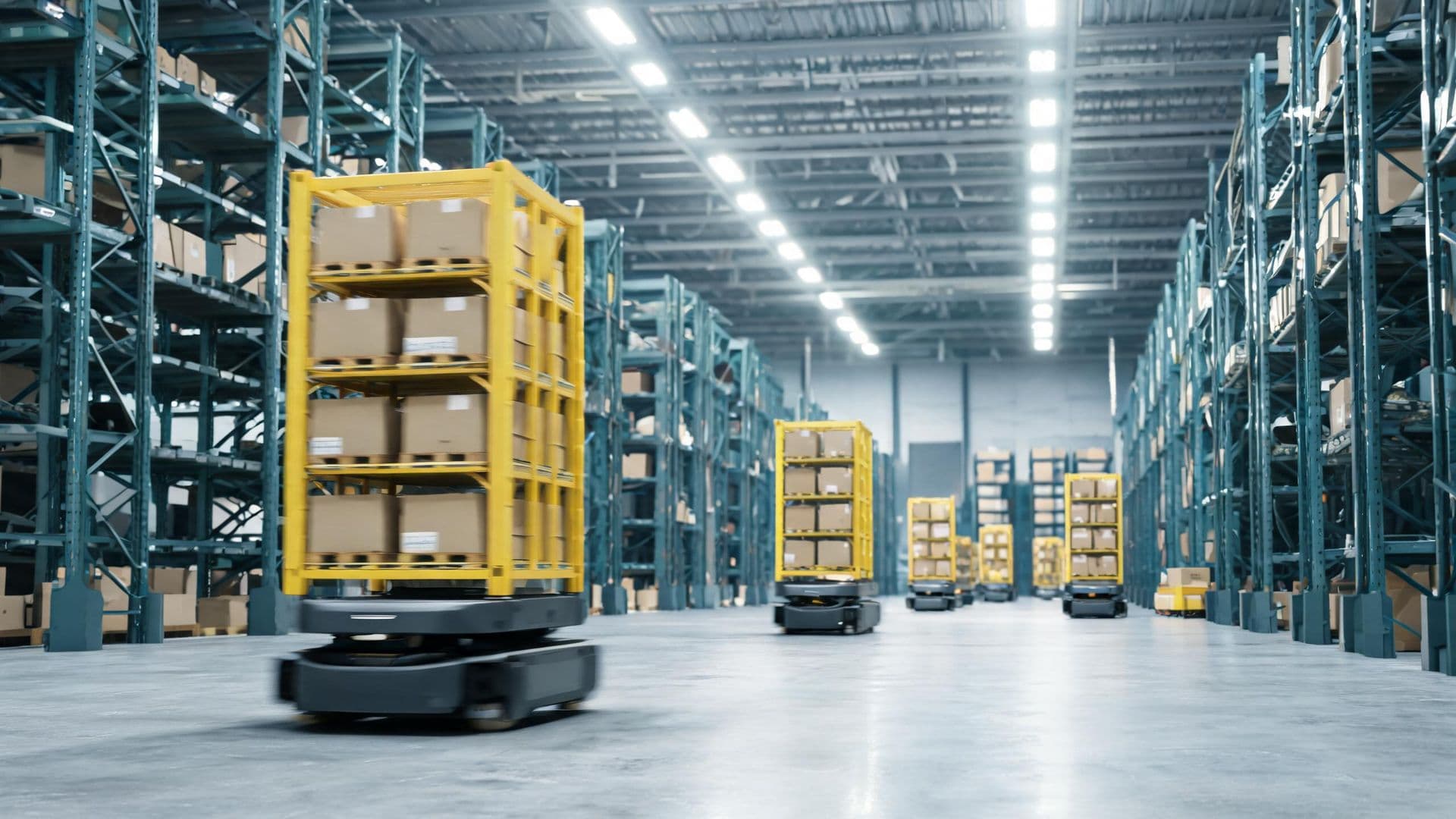 Illustrative image
The challenge
An e-commerce logistics provider operating a 46,000 m² (500,000 sq ft) fulfilment centre needed to dramatically increase throughput capacity to handle 3x order volume growth while maintaining accuracy and reducing operational costs in a tight labor market.
Labor shortage
The warehouse struggled to hire and retain workers for repetitive picking tasks. High turnover rates and rising wages created operational instability and unpredictable fulfilment capacity.
Limited throughput
Manual picking processes created bottlenecks during peak seasons. Workers walked an average of about 19 km per shift, with only 15% of time spent actually picking items.
Error rates
Human picking errors resulted in returns, customer complaints, and inventory discrepancies. Error rates spiked during high-volume periods when workers were fatigued.
Scalability
Existing automation solutions required fixed infrastructure (conveyors, AS/RS) with lengthy installation times and couldn't adapt to changing product mix or seasonal demands.
Impact figures describe the situation before the project, as the client reported it to us; we did not measure them.
Our solution
We designed the compute, perception and software core of an autonomous mobile robot (AMR) with on-device edge AI for real-time navigation, obstacle avoidance and fleet coordination, without dependency on cloud connectivity or fixed infrastructure.
System architecture
Decentralized architecture where each robot makes navigation decisions with on-device ML while coordinating with peers through mesh networking.
Robot perception layer
- 360° LiDAR for mapping and localization
- Depth cameras for obstacle detection
- Floor-facing camera for QR code navigation
- IMU for motion tracking and stability
- Ultrasonic sensors for close-range detection
Edge AI processing
- Custom compute board with on-SoC NPU
- Quantized ML models for real-time inference
- On-device SLAM (Simultaneous Localization & Mapping)
- Local path planning and obstacle avoidance
- Gesture and voice recognition for human interaction
Swarm coordination
- Peer-to-peer mesh networking (802.11s)
- Distributed task allocation algorithm
- Collision avoidance coordination protocol
- Dynamic route optimization
- Charging station queue management
Warehouse management integration
- WMS API integration for order dispatch
- Real-time inventory tracking
- Pick station orchestration
- Analytics dashboard and reporting
- Predictive maintenance system
Custom robot hardware design
- Compute Platform
- Custom board: Cortex-A78 + Mali GPU + 4 TOPS NPU
- LiDAR
- 16-channel 3D LiDAR, 100m range, 20Hz
- Cameras
- 4x depth cameras, 1x RGB with 120° FOV
- Payload Capacity
- Up to 30kg, adjustable shelving
- Battery
- 48V LiFePO4, 8-hour runtime, hot-swap capable
- Charging
- Autonomous docking, 15-min fast charge to 80%
- Speed & Positioning
- Up to 2 m/s loaded; ±5 mm at docking and QR-code fiducials, ±2 cm localization elsewhere in mapped areas
Embedded software stack
- Real-time Linux (PREEMPT_RT) for deterministic control
- ROS2-based modular architecture
- On-device SLAM with loop closure
- TensorFlow Lite for ML inference (<20ms latency)
- Mesh networking with <50ms peer communication
- Fail-safe behaviors and graceful degradation
- OTA firmware updates with A/B partitioning
On-device ML navigation & intelligence
The robots run multiple ML models on-device for real-time decision making without cloud dependency. Accuracy figures come from bench testing and the 20-robot pilot.
Visual SLAM enhancement
Lightweight CNN for feature extraction
±2 cm localization in mapped areas
Measured in pilot<10ms inference, 30 FPS
Dynamic obstacle classification
MobileNetV3 + custom head
98.5% object classification (humans, forklifts, pallets)
Bench-tested<15ms per frame
Path prediction
LSTM for trajectory forecasting
92% human path prediction (2 sec horizon)
Bench-testedPick verification
EfficientNet-Lite for item recognition
99.7% item verification accuracy
Bench-tested<50ms verification time
Anomaly detection
Autoencoder for operational anomalies
95% anomaly detection rate
Bench-testedImplementation timeline
Phase durations are approximate and cover the main engineering work only, so they add up to less than the 16 months programme.
Phase 1: Facility assessment & design
8 weeks- Warehouse layout analysis and 3D mapping
- Workflow optimization study
- Robot specification and custom design
- Safety assessment and compliance planning
Phase 2: Robot development & testing
20 weeks- Hardware prototyping and validation
- On-device ML model development and optimization
- Fleet coordination algorithm development
- Extensive simulation testing
Phase 3: Pilot deployment
12 weeks- 20-robot pilot in dedicated zone
- Real-world performance optimization
- Worker training and change management
- Safety validation
Phase 4: Full-warehouse rollout support
16 weeks- Support for the full-warehouse rollout
- WMS integration and workflow optimization
- Operations handover
Results & impact
The 20-robot pilot validated navigation, obstacle avoidance and fleet coordination in a live fulfilment zone. Fleet-wide throughput, accuracy and cost results belong to the client's operation and are not published here.
How to read the labels: Bench-tested = measured in bench or lab testing; Measured in pilot = measured during the project's pilot deployment; Client-reported baseline = the client's own figure for the situation before the project; we did not measure it. Figures without a label are specifications or project scope.
Localization accuracy
Measured in pilot±2 cm
In mapped areas
Obstacle classification
Bench-tested98.5%
Humans, forklifts and pallets
Detection-to-brake command
Bench-tested< 100 ms
Obstacle detection to brake command (not to standstill)
Technologies used
- ROS2
- TensorFlow Lite
- Cortex-A78
- On-SoC NPU
- 3D LiDAR
- Visual SLAM
- 802.11s Mesh
- MQTT
- PostgreSQL
- Redis
- Kubernetes
- React
- Grafana
Related case studies
Healthcare / Assistive Technology
Robotic prosthetic arm: EMG-controlled bionic limb with machine learning
Manufacturing / Heavy Industry