Hospitality / Smart Buildings
Hotel Call-Button System: Battery-Powered Wi-Fi Mesh Buttons for Staff Alerts and Guest Requests
For a hotel client in Oman we built battery-powered Wi-Fi mesh call buttons for staff distress alerts and guest requests, with alert location and a cloud dashboard and app. Completed by early 2025; 2-year battery life is the design target.
What we did: We designed the compact, battery-powered buttons and their RTOS firmware, the self-healing Wi-Fi mesh that covers the property, alert location and nearest-staff routing, the cloud dashboard and mobile app for managers and security teams, and end-to-end encryption designed with GDPR requirements in mind.
Hospitality client, Oman3 monthsTeam of 5
Published Last reviewed:
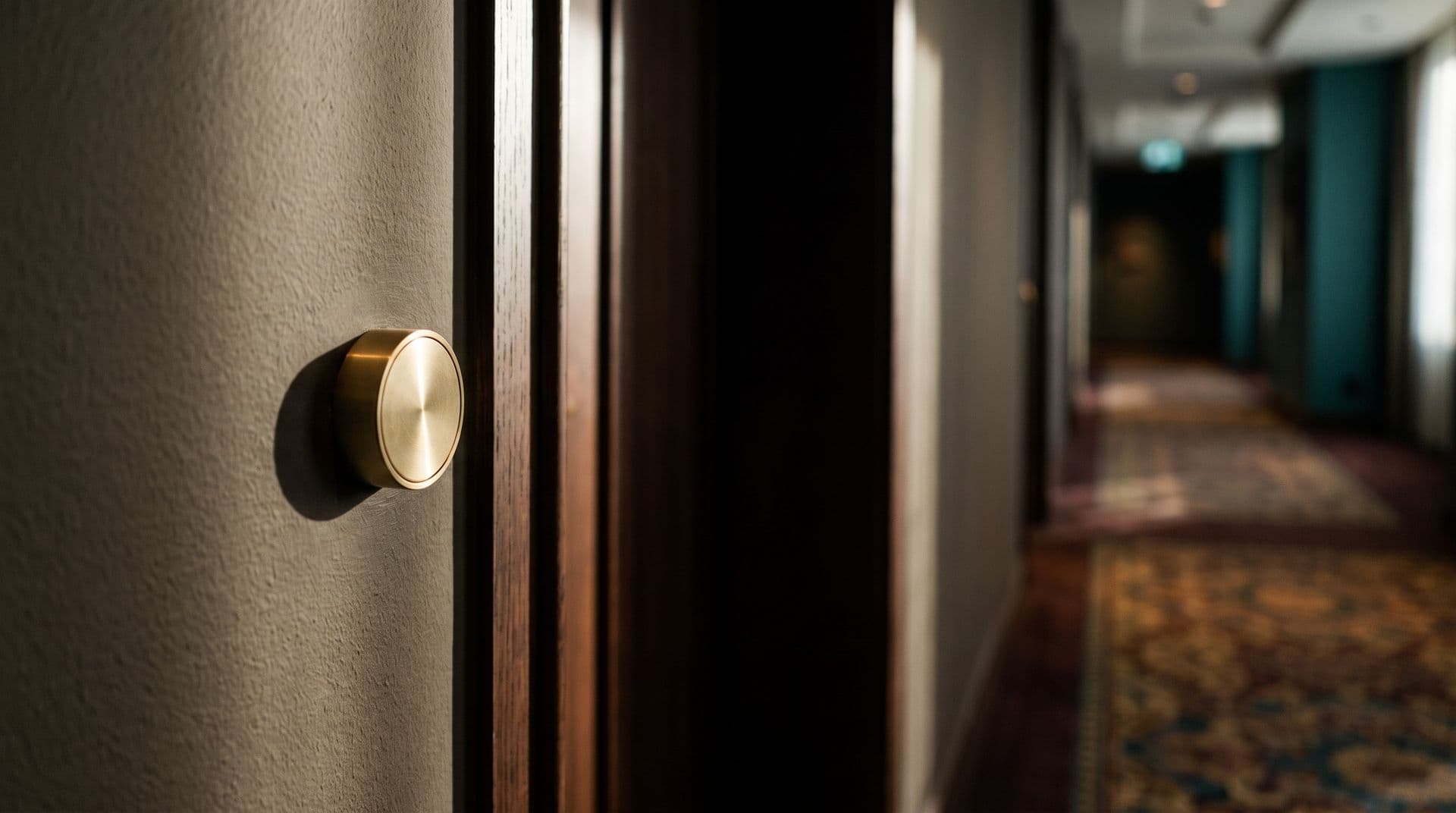 Illustrative image
The Challenge
Hotels need a reliable, real-time way for guests and staff to call for help: emergency alerts, staff distress calls, room-service and housekeeping requests. Wired panic buttons, radio alerts and intercoms have limited range, cost a lot to install and maintain, and are hard to scale across a large property.
Property-wide coverage
Alerts have to get through from every room, corridor and back-of-house area, with no dead zones.
Impact: No dead zonesInfrastructure cost
Running cables for wired buttons and intercoms is expensive and disruptive in an operating hotel.
Impact: No new cablingMore than a panic button
The same button should serve guest service requests and automation triggers, not only emergencies.
Impact: Multi-function buttonLow maintenance
Battery-powered buttons across a whole property are only practical if batteries last a long time.
Impact: Long battery lifeOur Solution
We built compact, battery-powered buttons that connect over a self-healing Wi-Fi mesh network covering the whole property. Each button can be configured for a different job: a staff distress button, a guest request for room service, housekeeping, concierge or maintenance, or an automation trigger such as Do Not Disturb. Alerts carry their location and service requests are routed to the nearest available staff member. Managers and security teams receive notifications in a cloud dashboard and mobile app, and communication is end-to-end encrypted.
System Architecture
Buttons, a property-wide mesh, and a cloud dashboard with a mobile app.
Buttons
- Compact, battery-powered button hardware
- Low-power RTOS firmware; 2-year battery life (design target)
- Configurable functions: distress, service request, automation trigger
Wi-Fi mesh network
- Property-wide coverage without dead zones
- Self-healing mesh for uninterrupted communication
- End-to-end encryption
Cloud and mobile
- Alerts with location for faster response
- Service requests routed to the nearest available staff
- Dashboard analytics on response efficiency
Key Design Points
| Network | Self-healing Wi-Fi mesh |
| Power | Battery; 2 years (design target) |
| Functions | Staff distress, guest requests, automation |
| Location | Included with each alert |
| Security | End-to-end encryption |
| Privacy framing | Designed with GDPR requirements in mind |
What We Delivered
- Battery-powered button hardware
- Low-power RTOS firmware
- Wi-Fi mesh networking with self-healing
- Staff distress alerts with location
- Guest service requests: room service, housekeeping, concierge, maintenance
- Automation triggers such as Do Not Disturb and housekeeping notifications
- Nearest-available-staff request routing
- Cloud dashboard and mobile app with real-time notifications
Outcome
The system gives the property instant, property-wide alerting over a Wi-Fi mesh, avoiding the range limits and dead zones of wired and radio-based systems and the cabling cost of wired intercoms. One button type serves both staff safety and guest services, alerts carry their location, and requests go to the nearest available staff member. The 2-year battery life is a design target. We do not publish a response-time improvement because no measurement is on record.
How to read the labels: Design target = an engineering target, not a field measurement.
Battery life
Design target2 years
Per button
Coverage
Property-wide
Self-healing Wi-Fi mesh with no dead zones
Installation
No new cabling
Lower installation cost than wired intercoms and radio systems
Design duration
3 months
Team of 5
Technologies Used
Related Case Studies
Smart Buildings / Retail / Occupancy Sensing
mmWave People-Counting Sensor: Privacy-Preserving Radar Occupancy Detection with Edge Processing
Public Safety / Government