Public Safety / Government
Smart police wearable: Real-time officer health monitoring & SOS alert system
Development of a rugged smart watch for police officers with SpO2, heart rate, skin temperature, ambient temperature and humidity, a VOC air-quality index, GPS tracking and an SOS alert system, piloted with officers and designed for state-wide deployment.
What we did: We designed the watch electronics (8-layer multi-sensor PCB, LTE and GPS antennas, ruggedized enclosure), the sensor-fusion, SOS and power-management firmware, the officer mobile app and the command-centre dashboard.
State police department, India10 months
Published Last reviewed:
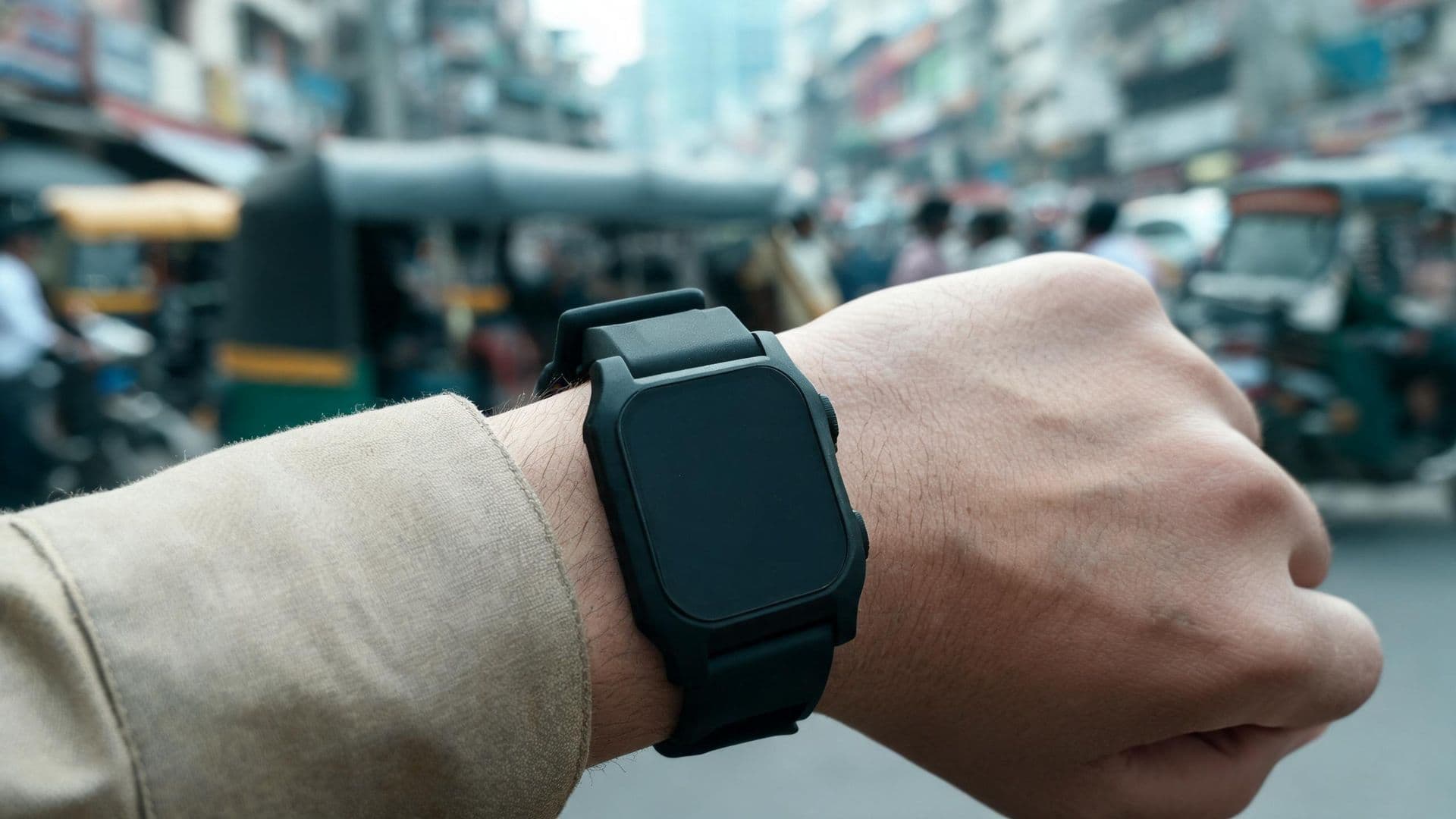 Illustrative image
The challenge
A state police department needed a comprehensive wearable solution to monitor officer health during duty, especially in extreme conditions, and provide instant emergency alerts when officers face life-threatening situations.
Officer health risks
Police officers face heat stroke, exhaustion, and cardiac events during demanding duties. No system existed to monitor their health in real-time.
Hazardous environments
Officers often work in environments with poor air quality, extreme temperatures, or chemical hazards without awareness of the risks.
Emergency response delays
When officers face danger, calling for backup takes precious seconds. An automatic, instant SOS system was needed.
Rugged requirements
The device needed to survive impacts, water, dust, and continuous 12+ hour shifts in challenging Indian climatic conditions.
Impact figures describe the situation before the project, as the client reported it to us; we did not measure them.
Our solution
We developed a rugged smart watch with health monitoring, environmental sensing, GPS tracking, and a one-touch SOS system that alerts the command centre and nearby officers.
System architecture
End-to-end officer safety platform with wearable device, mobile app, and command center dashboard.
Smart watch device
- PPG sensor for SpO2 and heart rate
- Infrared skin-temperature sensor (heat-stress trend, not core temperature)
- Environmental temp & humidity sensor
- Gas sensor for a VOC air-quality index
- GPS (+QZSS) positioning via the nRF9160
- SOS button with haptic feedback
- 6-axis IMU for fall and man-down detection
- BLE 5.0 + 4G LTE connectivity
Officer mobile app
- Real-time health dashboard
- Environmental hazard alerts
- Team member locations
- Voice communication
- Incident reporting
Command center
- Real-time officer tracking map
- Health anomaly alerts
- SOS incident management
- Resource dispatch system
- Historical analytics & reporting
Custom hardware design
- MCU
- nRF9160 (LTE-M + GPS)
- SpO2/HR Sensor
- MAX30102 PPG
- Skin Temp
- MLX90614 IR sensor (heat-stress trend input, not core temperature)
- Env Temp/Humidity
- SHT40 (±0.2°C accuracy)
- Air Quality
- BME680 gas sensor (VOC index)
- Motion
- 6-axis IMU for fall and man-down detection
- Battery
- 450mAh Li-Poly
- Display
- 1.4" AMOLED always-on
- Protection
- IP68 and MIL-STD-810H drop/shock (design targets; pre-compliance tested in-house)
Real-time monitoring firmware
- Continuous SpO2 monitoring (±2% target in the 94-100% range)
- Heart-rate tracking with irregular-rhythm flag (wellness indicator, not a diagnosis)
- Skin temperature monitoring every 30 seconds
- Environmental hazard detection and alerts
- VOC air-quality index calculation
- GPS tracking with configurable intervals
- One-touch SOS with fall detection
- Encrypted communication (AES-256)
- 72-hour battery optimization algorithms
Implementation timeline
Phase durations are approximate and some phases ran in parallel, so they add up to more than the 10 months programme.
Phase 1: Requirements & design
6 weeks- Field study with officers across units
- Use case analysis for different duty types
- Security and encryption requirements
- System architecture design
Phase 2: Hardware development
14 weeks- Multi-sensor PCB design (8-layer)
- Ruggedized enclosure design
- Antenna optimization (LTE + GPS)
- MIL-STD-810H pre-compliance tests
- 4 prototype iterations
Phase 3: Firmware development
12 weeks- Real-time sensor fusion algorithms
- Power optimization for 72hr battery
- SOS system with redundancy
- Secure boot and encrypted OTA
Phase 4: Platform development
10 weeks- Command center dashboard
- Mobile app for officers
- Backend infrastructure
- CAD system integration
Phase 5: Pilot & deployment
8 weeks- Officer pilot program
- Field testing in multiple conditions
- Training program development
- Phased state-wide rollout plan
Results & impact
The Smart Police Wearable was piloted with officers and engineered for state-wide deployment, to enable real-time health monitoring and fast emergency response on duty. Timing figures were bench-tested; battery life is a design target.
How to read the labels: Design target = an engineering target, not a field measurement; Bench-tested = measured in bench or lab testing; Client-reported baseline = the client's own figure for the situation before the project; we did not measure it. Figures without a label are specifications or project scope.
SOS response time
Bench-tested< 3 sec
Alert to command center
Battery life
Design target72 hours
6 duty shifts per charge
Sensors integrated
7
Health & environmental monitoring
Alert latency
Bench-tested< 10 sec
Sensor reading to dashboard alert
Technologies used
- nRF9160
- MAX30102
- MLX90614
- SHT40
- BME680
- LTE Cat-M1
- BLE 5.0
- React Native
- Node.js
- MQTT
Related case studies
Healthcare / Medical Devices
Medical wearable: Remote patient monitoring device for cardiac care
Consumer Electronics / Pet Tech