Smart Buildings / Retail / Occupancy Sensing
mmWave people-counting sensor: Privacy-preserving radar occupancy detection with edge processing
For a Dubai smart-building and retail client we built a camera-free mmWave radar sensor that counts people and detects presence, with edge AI filtering. Completed by early 2025; >95% people-count accuracy is the design target.
What we did: We integrated mmWave radar sensing, developed on-device (edge) AI filtering that separates people from static objects and moving clutter, designed the low-power, always-on RTOS system, added BLE, Wi-Fi, LTE or LoRa connectivity, and built a real-time occupancy dashboard with integrations for building-automation platforms.
Smart-building and retail client, Dubai, UAE4 monthsTeam of 4
Status: Completed (case study first published February 2025)
Published Last reviewed:
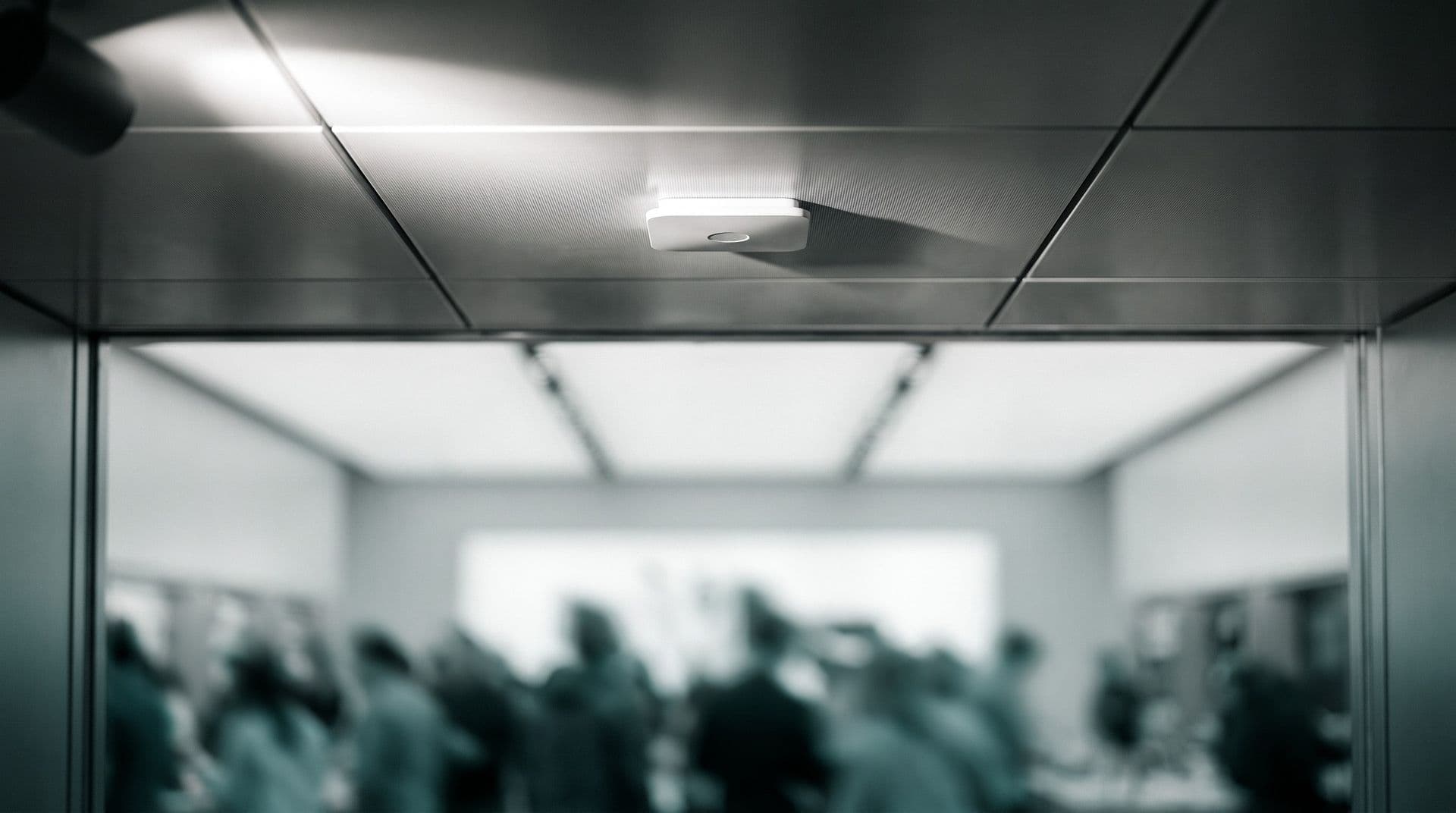 Illustrative image
The challenge
Common people-counting and presence sensors fall short: passive infrared (PIR) and ultrasonic sensors struggle in crowds and with people who stand still, and cameras raise privacy concerns and depend on light. The client wanted an accurate, real-time, privacy-preserving sensor using mmWave radar that detects presence, counts people and works in low visibility.
Accuracy in crowds
PIR and ultrasonic sensors miscount when several people move together or someone stays still.
Privacy
Cameras in shops and offices capture identifiable images, which many sites want to avoid.
Light and obstructions
Optical sensors depend on lighting and are confused by shadows and obstructions.
False triggers
Pets, HVAC airflow and moving objects can trigger simple motion sensors.
Impact figures describe the situation before the project, as the client reported it to us; we did not measure them.
Our solution
mmWave radar sends out millimetre-wave radio signals and measures the reflections, so it senses people's movement and position without forming an image and without needing light. We added AI-based filtering on the device to tell people apart from static objects and moving clutter, and ran all detection at the edge in a low-power, always-on design, so no cloud processing is needed. Occupancy data goes out over BLE, Wi-Fi, LTE or LoRa to a real-time dashboard and to building-automation platforms.
System architecture
Radar sensing and edge AI on the device; occupancy data to the building.
Sensing
- mmWave radar sensor
- Non-intrusive people detection
- Works in darkness and low visibility
Edge processing
- AI-based filtering: people vs static objects and moving clutter
- Filtering designed to reject pets, HVAC airflow and objects
- Low-power, always-on RTOS firmware
Connectivity and analytics
- BLE, Wi-Fi, LTE or LoRa connectivity
- Real-time occupancy dashboard
- Integration with smart-building and home-automation platforms
Key design points
- Sensor
- mmWave radar
- Processing
- On-device (edge), no cloud needed
- Filtering
- AI-based clutter rejection
- Connectivity
- BLE / Wi-Fi / LTE / LoRa
- Privacy
- No camera, no images
- Counting accuracy
- >95% of people counted correctly (design target)
What we delivered
- mmWave radar integration
- Edge AI filtering for people vs clutter
- Low-power, always-on presence detection
- Multi-radio connectivity: BLE, Wi-Fi, LTE, LoRa
- Real-time occupancy dashboard
- Building-automation integration for occupancy-based lighting and HVAC control
Outcome
We delivered a low-power, always-on radar sensor that counts people and detects presence in real time without cameras, with filtering designed to reject pets, HVAC airflow and moving objects. The >95% figure is a design target for people counted correctly against the actual count; the test conditions for it (crowd density, mounting height) are not on record, and neither the radar band nor the chipset is published here. Occupancy data can drive occupancy-based lighting and HVAC control; we do not publish energy-saving figures.
How to read the labels: Design target = an engineering target, not a field measurement; Client-reported baseline = the client's own figure for the situation before the project; we did not measure it. Figures without a label are specifications or project scope.
People-counting accuracy
Design target>95%
People counted correctly vs actual count, including dynamic environments
Privacy
No camera
Radar sensing only; no images captured
Building integration
Lighting + HVAC
Occupancy data for smart-building and home-automation platforms
Design duration
4 months
Team of 4
Technologies used
- mmWave radar
- Edge AI
- RTOS
- BLE
- Wi-Fi
- LTE
- LoRa
- Occupancy analytics
- Building automation
Related case studies
Smart Buildings / Real Estate / PropTech