Consumer Electronics / Audio / Soundbars
Dolby Atmos Soundbar Electronics: 7.1.2 / 7.1.4 Architecture on the Rockchip RK2118G
For an Indian consumer-audio brand we are designing the electronics of a Dolby Atmos 7.1.2 / 7.1.4 soundbar on the Rockchip RK2118G audio SoC. Status: architecture and feature-freeze stage (September 2026); schematic design follows sign-off.
Indian consumer-audio brandStarted September 2026Rapid Circuitry hardware team
Published Last reviewed:
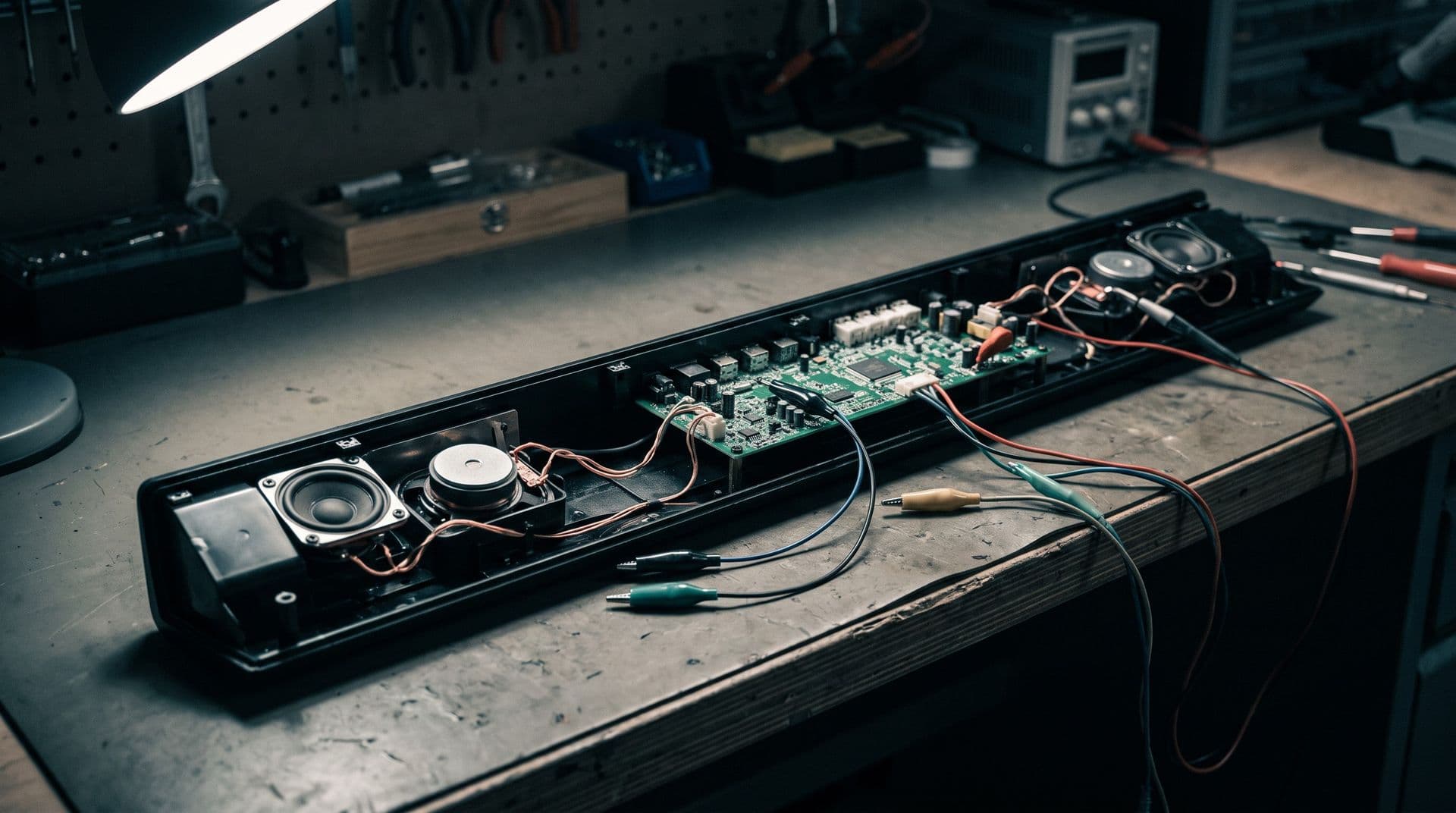 Illustrative image
The Challenge
The brand wanted a Dolby Atmos soundbar in two variants, 7.1.2 and 7.1.4, built on a current audio SoC. The vendor's reference design is a starting point, not a product: it has fewer amplifier channels than a 7.1.4 system needs and carries features a consumer soundbar does not. The client needed a clear, signed-off feature set before any schematic work began.
Not enough amplifier channels
7.1.2 needs 10 amplified channels and 7.1.4 needs 12, including a subwoofer feed. The starting reference did not cover that.
Impact: 10–12 channels requiredAtmos needs the right input
Optical S/PDIF carries at most Dolby Digital 5.1. Discrete Atmos and TrueHD 7.1.4 need HDMI with eARC.
Impact: HDMI eARC is mandatoryTwo SKUs, one design
Designing two separate boards for 7.1.2 and 7.1.4 doubles layout, validation and sourcing effort.
Impact: Shared platform wantedStandby power
Consumer audio products must idle at very low power, which has to be planned into the power tree from the start.
Impact: < 0.5 W standby targetOur Solution
We worked through the vendor reference sheet by sheet and turned it into a client-facing feature-freeze workbook: every architecture choice, every reference feature to keep or drop, every required addition and every power, thermal and compliance item, each with a recommendation and a sign-off field.
System Architecture
The recommended system architecture.
Audio processing and channels
- Rockchip RK2118G: dual Arm Cortex-M33 with HiFi4 DSP cores
- One 12-channel-capable schematic; depopulate for the 7.1.2 SKU
- Additional multi-channel Class-D amplifiers for the missing channels
- I²S/TDM capacity checked: it is not the limit for 12 channels
Inputs and connectivity
- HDMI output with eARC for Atmos and TrueHD
- Fewer HDMI inputs than the reference
- One Bluetooth radio instead of two
- Ethernet, coaxial S/PDIF, microSD and guitar input dropped
System and power
- Bar + wireless subwoofer + two wireless satellites
- Internal AC-DC supply instead of an external DC adapter
- Power rails partitioned by sleep state for the standby target
- Dolby decoding licensed, never reverse-engineered
Feature-Freeze Workbook
| Architecture decisions | 27 |
| Reference features (keep/drop) | 39, each cited to its reference sheet |
| Required additions | 13 |
| Power, thermal and compliance items | 10 |
| Formats | Excel workbook with drop-downs + PDF |
| Sign-off | Completion tracker and sign-off block |
What We Delivered
- Feature-freeze checklist workbook with drop-down keep/drop choices
- Matching PDF generated from the same content source, so the two never drift
- Recommendation for each architecture decision
- Completion tracker and client sign-off block
Key Engineering Decisions
Recommendations made to the client, with the reason for each.
Design once for 12 channels
7.1.2 and 7.1.4 share one board
Leave the extra amplifier channels unpopulated on 7.1.2
One layout, one validation, one supply chain
HDMI eARC is non-negotiable
If the product claims Atmos
Optical tops out at Dolby Digital 5.1
eARC carries discrete Atmos and TrueHD
Internal mains supply
Replace the reference's external DC adapter
No external power brick
Adds a mains-safety and thermal design task
Keep the client document clean
Hardware choices only
Licensing and internal questions kept out of the client selection sheet
Handled in a separate track
Outcome and Status
The feature-freeze workbook was delivered to the client for keep/drop selection in September 2026. Schematic and layout design follow once the client signs off the feature set. Figures such as the standby target are design targets, not measurements.
Decisions framed
89
27 architecture, 39 keep/drop, 13 additions and 10 power, thermal and compliance items
Next step
Sign-off
Client selection, then schematic design
Technologies Used
Related Case Studies
Consumer Electronics / Audio / TWS Earbuds
TWS Earbuds Electronics: BES2710 Platform Schematic Reconstruction and a Reusable Audio Block Library
Consumer Electronics / Fitness Wearables