Transportation / Logistics / Connected Vehicles
Connected Fleet: LTE Cat 1bis Telematics Control Unit and Edge AI for Commercial Vehicles
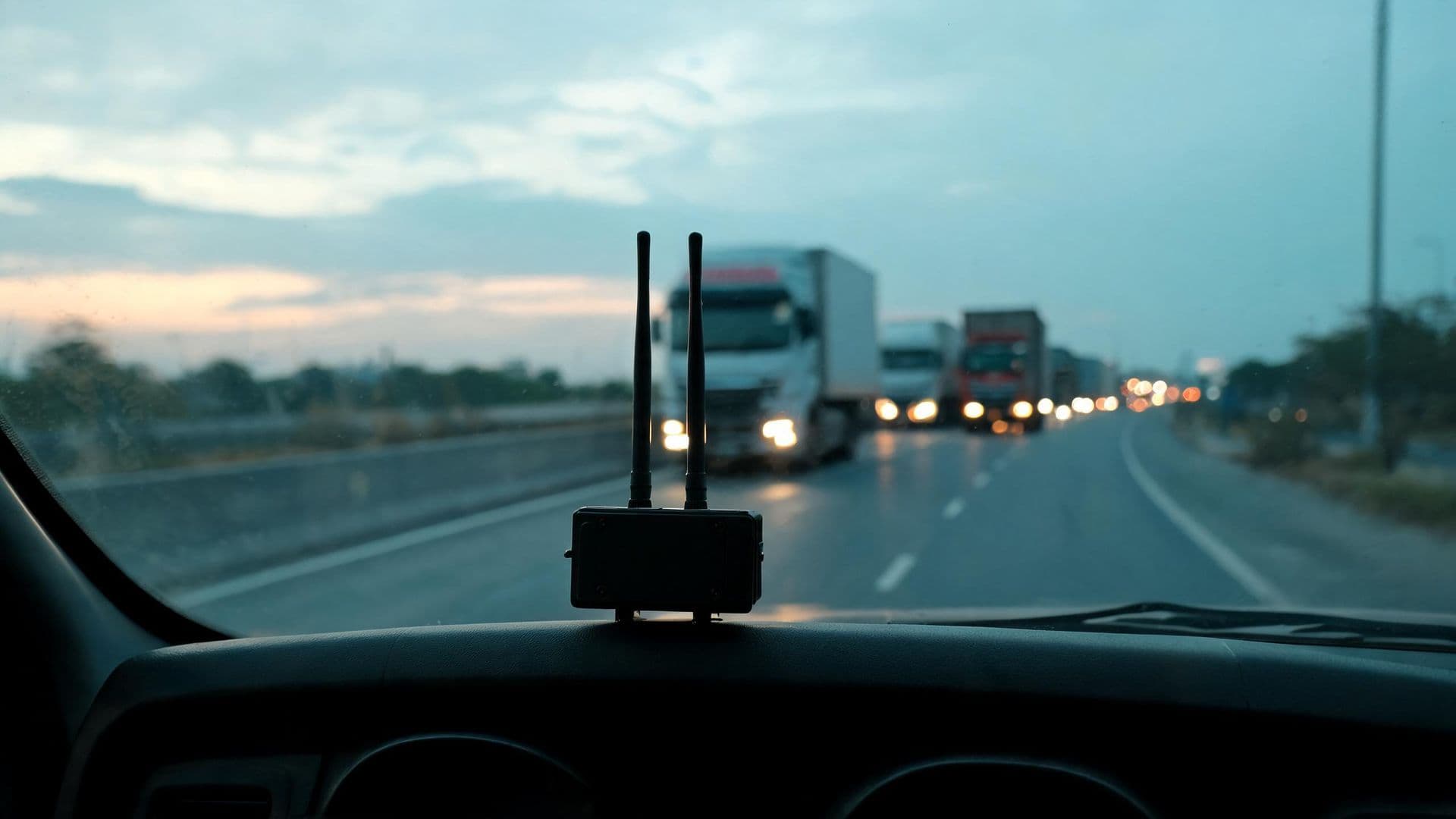
Rapid Circuitry designed an LTE Cat 1bis telematics control unit (TCU) with an on-vehicle AI processor, the vehicle firmware and the fleet platform for a logistics company's commercial vehicles, validated in a 100-vehicle pilot and then rolled out across the fleet. Fleet-wide fuel and safety results are the client's and are not published here.
What we did: We designed the TCU hardware (Quectel EC200U or Cavli C16QS LTE Cat 1bis module per region, GNSS, CAN / J1939 / J1708 vehicle interfaces, 12/24 V vehicle power input, Jetson Orin Nano 8GB AI module with road and cabin cameras), the vehicle firmware and driver-monitoring models, and the cloud fleet platform used for the fleet rollout.
Logistics and transportation company18 months
Published Last reviewed:
 Illustrative image
The Challenge
A logistics company operating a large fleet of heavy commercial vehicles across a wide geography needed to modernize their fleet management to reduce operational costs, improve safety, and meet stricter emission regulations while scaling operations.
Fuel Cost Volatility
Fuel represented 35% of operating costs. Inefficient routing, driver behaviors (harsh braking, excessive idling), and lack of real-time optimization led to significant waste.
Safety Concerns
Driver fatigue, distracted driving, and lack of real-time monitoring contributed to accidents. Post-incident analysis was hampered by limited data availability.
Maintenance Surprises
Breakdowns occurred unexpectedly, causing delivery delays and expensive roadside repairs. Scheduled maintenance often replaced parts prematurely or missed developing faults.
Limited Visibility
Existing 2G/3G trackers provided location updates every 30 minutes with no real-time diagnostics. Rural coverage gaps left vehicles unmonitored for hours.
Compliance Burden
Manual logging of driver hours, vehicle inspections, and emissions reporting was error-prone and time-consuming, risking regulatory penalties.
Impact figures describe the situation before the project, as the client reported it to us; we did not measure them.
Our Solution
We designed an LTE Cat 1bis telematics unit with edge computing, the firmware that runs on it, and the fleet platform behind it, enabling real-time vehicle monitoring and AI-driven driver-safety analytics.
System Architecture
Multi-layer architecture: LTE Cat 1bis cellular for telemetry and event uploads, with AI processing on the vehicle so safety alerts never depend on the network.
Vehicle Hardware Layer
- Custom telematics control unit (TCU): LTE Cat 1bis cellular module, GNSS, vehicle-bus interfaces and a Jetson Orin Nano 8GB AI module
- Vehicle-bus gateway: CAN (J1939, OBD-II over ISO 15765-4) and J1708 for older heavy-truck ECUs
- Road-facing camera and cabin-facing driver-monitoring camera with 940 nm IR illumination
- Wireless TPMS sensors for tyre pressure and temperature
- Fuel-flow sensors on pulse inputs for measured consumption
- Temperature probes for cold-chain monitoring
Cellular Connectivity Layer
- LTE Cat 1bis (up to 10 Mbps down / 5 Mbps up) on a Quectel EC200U or Cavli C16QS module, the variant chosen to match each region's LTE bands
- Single LTE antenna: Cat 1bis drops the receive-diversity antenna that Cat 1 needs, which simplifies antenna placement on a truck
- Multi-carrier SIM / eSIM profile switching for coverage gaps
- Store-and-forward buffering: telemetry and event clips upload when coverage returns
Edge Computing Layer
- On-vehicle AI processor (NVIDIA Jetson Orin Nano 8GB)
- Real-time driver behavior analysis
- Local video analytics and event detection
- Predictive maintenance inference
- Offline operation with sync on reconnect
Cloud Platform Layer
- Fleet management command center
- Route optimization engine
- Predictive analytics platform
- Compliance automation system
- Customer delivery tracking portal
Custom Telematics Hardware
| AI Module | NVIDIA Jetson Orin Nano 8GB (260-pin SO-DIMM, 69.6 × 45 mm): 1024-core Ampere GPU with 32 Tensor Cores, 6-core Arm Cortex-A78AE, 8 GB 128-bit LPDDR5; 40 TOPS sparse INT8 in the 7–15 W power modes |
| Cellular (option A) | Quectel EC200U, LTE Cat 1bis, 10 Mbps DL / 5 Mbps UL; EC200U-CN or EC200U-EU band variant, with 2G fallback; 3.3–4.3 V supply; 28 × 31 × 2.4 mm LCC |
| Cellular (option B) | Cavli C16QS, LTE Cat 1bis (3GPP Rel-14), 10 Mbps DL / 5 Mbps UL; regional band SKUs; optional integrated eSIM; 3.4–4.2 V supply; 26.5 × 22.5 × 2.3 mm LGA |
| Cellular Host Interface | USB 2.0 and UART to the host on both modules, so one driver and data stack serves either regional build |
| GNSS | Cellular module's integrated GNSS (GPS + BeiDou; Galileo and GLONASS added on EC200U-EU) with an active antenna, for tracking, geofencing and route deviation |
| Antennas | One LTE antenna (no diversity port on Cat 1bis) plus an active GNSS antenna |
| Vehicle Buses | CAN for SAE J1939 (heavy trucks) and OBD-II over ISO 15765-4, plus J1708 for older heavy-truck ECUs; CAN transceivers protected against bus shorts to the 24 V battery line |
| Power Input | Wide-input supply for 12 V and 24 V vehicles: reverse-battery protection, TVS and surge stopper for ISO 7637-2 transients and ISO 16750-2 load dump, and an ignition-sense input |
| Power Sequencing | Jetson rail enabled only after the input is stable; hold-up energy for a controlled shutdown and file close when ignition or battery is lost |
| Cameras | Road-facing camera and cabin driver-monitoring camera on MIPI CSI-2; 940 nm IR illumination for night-time eye tracking |
| Video Encoding | Software H.264 / H.265 on the Cortex-A78AE cores (Orin Nano has no hardware video encoder), so recording is 1080p-class; event clips re-encoded at a low bitrate for the 5 Mbps Cat 1bis uplink |
| Storage | Industrial-temperature NVMe SSD on PCIe (the Orin Nano module has no eMMC), sized for loop recording and store-and-forward buffering |
| Accessory I/O | Digital inputs (ignition, doors), pulse inputs for fuel-flow sensors, a wireless TPMS link and cold-chain temperature probes |
| Thermal | Fanless: the module heat-spreader is bonded to the aluminium enclosure; Jetson power mode capped so driver monitoring keeps priority in a hot cab |
| Temperature Ratings | Jetson Orin Nano −25 °C to 105 °C junction; cellular modules −40 °C to +85 °C |
| Design Targets | E-Mark (UN ECE R10) and IP67 targets; automotive-grade parts where available |
Vehicle Software Features
- Real-time vehicle-bus decoding (SAE J1939, J1708, OBD-II over ISO 15765-4)
- Telemetry streaming over LTE Cat 1bis with store-and-forward buffering to local storage
- On-device AI inference for driver monitoring
- Loop recording on the vehicle; event clips re-encoded in software at a low bitrate and uploaded over cellular
- Secure boot on the Jetson and power-cut / tamper event reporting
- OTA updates with rollback capability
- Geofencing and route deviation alerts
On-Vehicle AI Analytics
Edge AI enables real-time decision making without cloud latency, critical for safety applications and areas with poor connectivity. Driver-monitoring figures were measured on pilot-fleet data; the others are design targets.
Driver Fatigue Detection
CNN with eye-tracking and head pose
97% drowsiness detection
Measured in pilot<100ms continuous monitoring
Distraction Detection
Multi-task CNN (phone use, smoking, eating)
95% distraction event detection
Measured in pilotReal-time with immediate alert
Forward Collision Warning
Object detection + trajectory prediction
99.2% vehicle/pedestrian detection
Design target<50ms for collision risk assessment
Predictive Maintenance
Multivariate time-series (CAN + sensors)
89% fault prediction accuracy
Design targetEco-Driving Coach
Reinforcement learning-based optimization
Real-time driving score
Implementation Timeline
Phase durations are approximate and cover the main engineering work only, so they add up to less than the 18 months programme.
Phase 1: Assessment & Design
10 weeks- Fleet composition and route analysis
- Network coverage assessment
- Hardware specification and design
- Integration architecture planning
Phase 2: Prototype & Pilot
14 weeks- Hardware prototyping and validation
- 100-vehicle pilot deployment
- AI model training on fleet data
- Platform MVP development
Phase 3: Production & Fleet Rollout
20 weeks- TCU production for the fleet rollout
- Installation rollout
- Driver training programs
- Full platform deployment
Phase 4: Optimization & Enhancement
12 weeks- AI model refinement with production data
- Route optimization calibration
- Advanced analytics deployment
- Full handover and support transition
Results & Impact
The 100-vehicle pilot validated the TCU, the CAN decoding and the on-vehicle driver-monitoring models before the fleet rollout. Fleet-wide fuel, accident, utilisation and cost results are the client's and are not published here.
How to read the labels: Measured in pilot = measured during the project's pilot deployment; Design target = an engineering target, not a field measurement; Client-reported baseline = the client's own figure for the situation before the project; we did not measure it. Figures without a label are specifications or project scope.
Driver Fatigue Detection
Measured in pilot97%
Drowsiness events detected, eye-tracking and head pose
Distraction Detection
Measured in pilot95%
Phone use, smoking, eating
Collision-Risk Assessment
Design target< 50 ms
On-vehicle forward collision warning latency
Technologies Used
Related Case Studies
Logistics / Warehousing / Robotics
Edge AI Robotics: Compute, Perception and On-Device Navigation for Warehouse AMRs
Manufacturing / Heavy Industry