Drones / Hydrogen Power / Aerospace
Hydrogen Drone Power System: 5 kW Fuel-Cell Powerpack Integration, Thermal and Mass Study
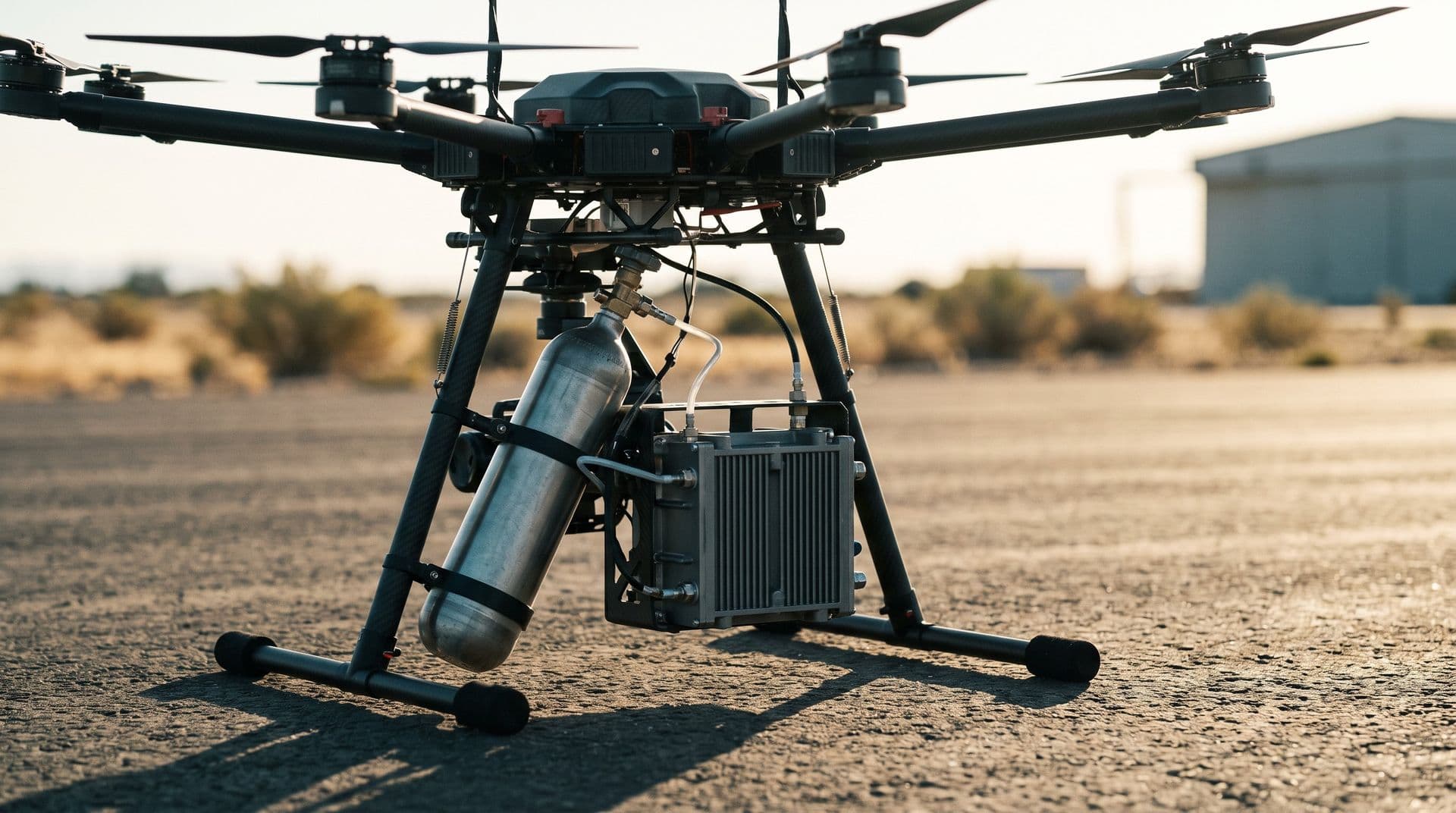
For a hydrogen-powertrain venture that our founder co-founded, we designed the integration of a 5 kW fuel cell and DC-DC into a heavy-lift drone powerpack, with thermal and mass analysis. Status: design study (2026); no flight hardware yet.
Hydrogen-powertrain venture co-founded by our founder (related party)Design study: June–July 2026Rapid Circuitry engineering team
Published Last reviewed:
 Illustrative image
The Challenge
A hydrogen fuel cell can fly a heavy-lift drone for longer than batteries, but only if the whole powerpack is light enough, stays cool enough and can follow the fast load changes of a multirotor. The venture needed an engineering answer to a simple question before building hardware: can a 5 kW fuel-cell powerpack beat a lithium-ion pack on a 35 kg, 60-minute drone?
Mass budget
Every kilogram of stack, DC-DC, enclosure and hydrogen storage comes out of payload or flight time, so the powerpack mass decides whether hydrogen is worth it.
Impact: Powerpack ceiling set by MTOWCooling at altitude and heat
An air-cooled stack loses margin as air gets hotter and thinner. The powerpack had to be checked at hot-day and high-altitude conditions.
Impact: 45 °C and 3000 m caseSlow fuel cell, fast motors
A PEM stack responds in seconds while motor controllers change load in tens of milliseconds, and the stack cannot absorb regenerated energy on descent.
Impact: Buffer battery requiredReal geometry, not placeholders
Early layouts used placeholder boxes. Airflow direction, connector faces and masses had to come from the vendors' actual CAD.
Impact: Vendor STEP modelsOur Solution
We designed a modular fuel-cell and DC-DC enclosure through several CAD iterations, rebuilt it around the vendors' real 3D models, built an analytical thermal network for the stack, and ran an aircraft-level power and mass closure to see where the design stands against a lithium-ion baseline.
System Architecture
Hydrogen to motor bus, with a battery to cover transients.
Fuel-cell power chain
- 5 kW air-cooled PEM stack (10.65 kg)
- Three-level buck DC-DC: 60–110 V in, 52 V rated out, 120 A, CAN 2.0B
- Rated 5 kW is the DC-DC input point, so ~4.8–4.9 kW reaches the bus
- 300 bar Type IV hydrogen storage in the mass model
Energy buffer
- Buffer battery covers transients and descent regeneration
- Sized at 1.5× hover transient for 90 s: about 54 Wh
- 12S, 6–8 Ah, 20C or more, about 2.0–2.6 kg
- Baseline 14S Li-ion battery charge-capped at 4.10 V per cell
Airframe fit
- Hexacopter with 30-inch-class integrated propulsion units
- Hover power model with 12% airframe download and 0.2 kW avionics
- ~4.6 kW hover at 35 kg: one DC-DC is enough
- Enclosure built around the vendors' STEP models, zero interference
Key Figures (model outputs and vendor data)
| Stack temperature, 25 °C sea level, 5 kW | 53 °C (+22 K margin) |
| Stack temperature, 35 °C sea level, 5 kW | 64 °C (+11 K margin) |
| Stack temperature, 45 °C / 3000 m, 5 kW | 82 °C (−7 K, trips) |
| Same condition derated to 3.5 kW | 71 °C (+4 K, marginal) |
| Powerpack mass ceiling at 35 kg / 60 min | 12.6 kg |
| Current powerpack estimate | 19–21 kg |
| Realistic floor after weight actions | ~13.5–15.5 kg |
| With a 5–7 kg drone-class stack | ~89 min at zero payload (model) |
What We Delivered
- Enclosure design package (v1) with layout drawings
- Parametric Fusion 360 enclosure models, v2 to v7
- v4 rebuilt around the vendors' real STEP geometry
- Analytical thermal network, script and results
- Aircraft-level hover-power and mass-closure model
- Ventilated aero-shroud variant and a real-fit enclosure with interference check
- Open-items list for design freeze
Key Engineering Decisions
What the analysis showed, and what we recommended.
Verify against vendor CAD
Placeholder layouts hid real errors
The DC-DC was rotated 90° and its mass assumed 5–6 kg
Real CAD: 2.79 kg and a different airflow axis
Mass beats efficiency
Choosing propulsion units
A more efficient but heavier unit cost more hydrogen than it saved
The lighter 30-inch-class hexacopter won
The stack is now the limit
10.65 kg is 85% of the 12.6 kg powerpack budget
Enclosure savings alone cannot close the gap
Recommended a lighter drone-class stack
Derate for hot, high days
Thermal model at 45 °C and 3000 m
5 kW trips the stack; 3.5 kW is marginal
35 kg MTOW holds only up to ~35 °C at sea level
Outcome and Status
The study gave the venture a clear, numbers-backed position: with the current stack the aircraft reaches about 45 minutes, roughly a tie with a good lithium-ion pack of the same mass, and a lighter drone-class stack is what turns it into a product. All figures are analytical model outputs or vendor data. No flight hardware had been built or flown when this was written.
Endurance with current stack
~45 min
Model, at a 14 kg powerpack; lithium-ion at the same mass ~40–42 min
With a drone-class stack
~89 min
Model, zero payload; or 60 min with ~3.6 kg payload
Errors caught in CAD review
4
DC-DC orientation, DC-DC mass, stack terminal geometry and mounting pattern
Technologies Used
Related Case Studies
Robotics / Motor Control
Robotic Arm Controller Board: STM32WB Six-Axis Motor-Control Schematic and Pre-Layout Audit
Robotics / Prosthetics / Motor Control