IoT & Wireless Communication
Satellite IoT Hardware Design 2026: NTN Modules & Antennas

- IoT Devices
- Wireless Connectivity
- 5G IoT
- +2 more
Contents· 8 sections
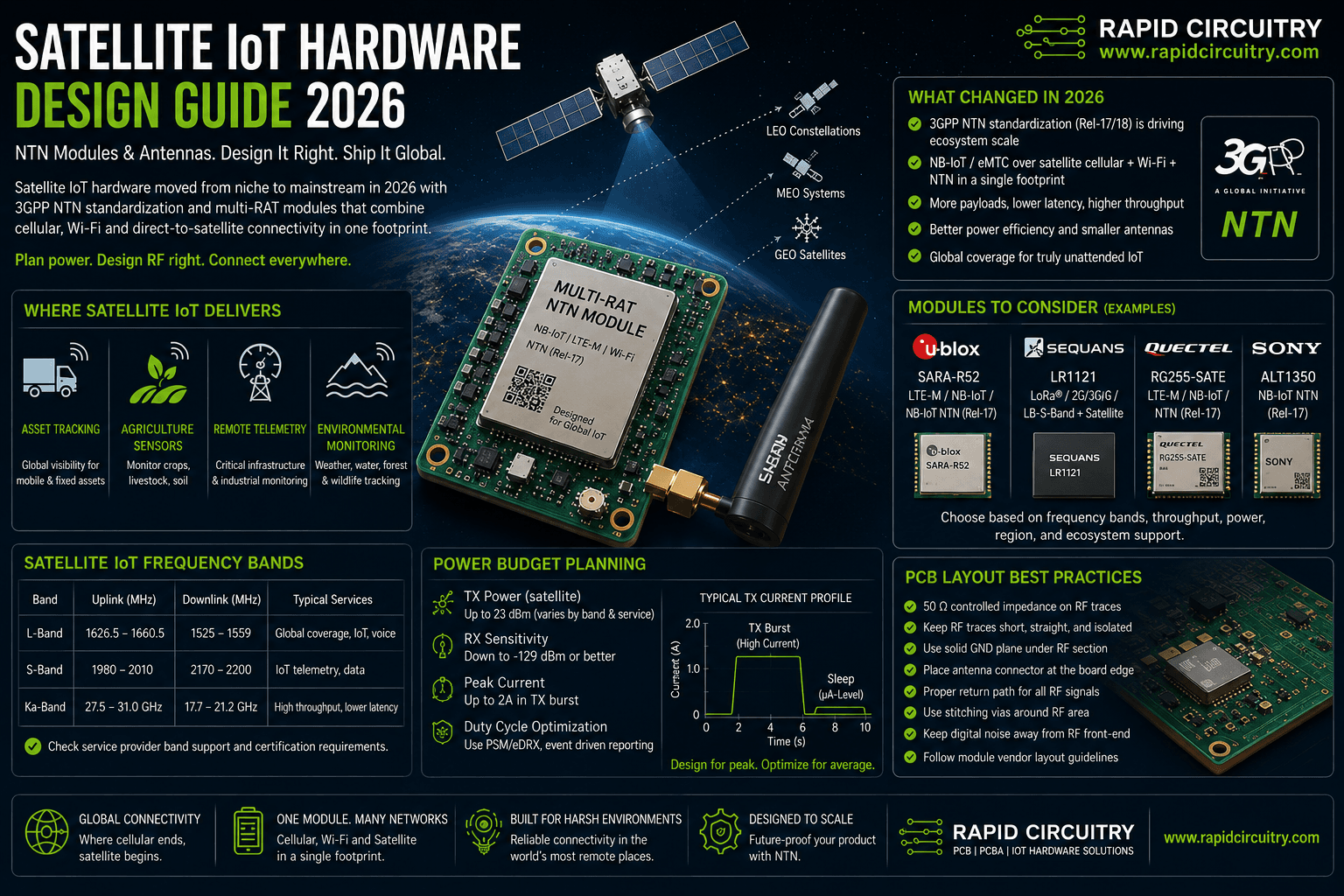
Satellite IoT hardware moved from a niche category to a mainstream design choice in 2026, driven by 3GPP NTN standardization and the first wave of multi-RAT modules that combine cellular, Wi-Fi, and direct-to-satellite radios in a single footprint. Hardware teams shipping asset trackers, agricultural sensors, and remote telemetry products now face a real selection problem rather than a coverage problem. This guide walks through what changed, which modules and antennas to consider, and how to plan power and PCB layout for satellite IoT hardware that has to work on the first revision.
Key Takeaways
- 3GPP Release 17 added NB-IoT and eMTC over Non-Terrestrial Networks; Release 19 work items extend this with store-and-forward operation and RedCap NTN.
- NTN-capable modules now integrate GNSS, an L-band or S-band PA, and dual-mode cellular fallback in a single footprint.
- Antenna selection drives more program risk than the module choice itself, particularly when cellular, satellite, and Wi-Fi share an enclosure.
- Power budgets for satellite IoT hardware shift toward transmit bursts; battery sizing must assume worst-case satellite link conditions, not average current.
- Soft-handover and dual-RAT firmware behavior should be validated on hardware before final PCB spin.
- Regulatory certification adds satellite-operator conformance on top of standard cellular type approval.
What’s Driving Satellite IoT Hardware in 2026
The two drivers are standards and silicon. On the standards side, 3GPP Release 17 added native NB-IoT and eMTC NTN profiles, treating the satellite as a transparent bent-pipe relay while leaving the eNB on the ground. The UE uses a GNSS fix plus satellite ephemeris (broadcast in system information) to pre-compute Doppler shift and timing advance. Release 18 introduced refinements; Release 19 work items add store-and-forward operation, RedCap over NTN, and early regenerative-payload support, with completion targeted through 2026 and commercial silicon following thereafter. Iridium’s NTN Direct service, planned to go live in 2026 over Iridium’s L-band fleet, is positioned as the first global standards-based NB-IoT NTN direct-to-device offering. (3GPP NTN overview)
On the silicon side, multi-RAT modules are reshaping bills of materials for satellite IoT hardware. The Blues Notecard for Skylo, shipping since March 2026, packs NB-IoT and LTE-M cellular, 3GPP NB-IoT NTN over Skylo’s L-band service, Wi-Fi, and GNSS into a single module priced near 89 USD with no recurring satellite subscription. Quectel, Sequans, Sony Semiconductor Israel (formerly Altair), and u-blox all now ship NTN-ready cellular modules with similar feature sets. The hardware decision in 2026 is no longer “satellite or cellular” but rather which combination of RATs your duty cycle, latency, and unit economics support.
Who actually needs satellite IoT hardware?
Devices that operate beyond reliable terrestrial coverage are the obvious candidates: pipeline monitors, livestock collars, container trackers, off-grid energy sites, mining equipment, and maritime sensors. Less obvious is the urban backup case, where a logistics tracker uses satellite only when both cellular and Wi-Fi fail. The economics work because NTN traffic is metered in bytes rather than connection-time, and the falling cost of satellite-capable modules makes the BOM penalty under 20 USD in many designs.
Choosing an NTN-Capable Module for Satellite IoT Hardware
Module selection in 2026 comes down to four axes: which 3GPP release the modem implements, which satellite operator it certifies against, the RF front-end coverage, and integration depth (host MCU, GNSS, and software stack).
| Module class | Cellular RAT | Satellite RAT | GNSS | Typical use case |
|---|---|---|---|---|
| Cellular-first with NTN fallback | LTE-M / NB-IoT (Cat-M1, Cat-NB1/NB2) | 3GPP Rel-17 NB-IoT NTN | Multi-constellation | Asset trackers, smart meters |
| Multi-RAT integrated | NB-IoT and LTE-M | 3GPP NB-IoT NTN (operator-specific) | Multi-constellation | Logistics, emergency telemetry |
| Satellite-primary | None or 2G fallback | Proprietary L-band (Iridium SBD/Certus, Globalstar) | Often external | Maritime, remote SCADA |
| RedCap NTN (Rel-19 roadmap) | 5G NR RedCap | 5G NR NTN | Multi-constellation | Mid-rate IoT, image snapshots |
Cellular-first modules suit devices that mostly live within terrestrial coverage and need satellite only as a safety net. Multi-RAT integrated modules trade a slightly higher BOM for true global operation without per-device subscription friction. Satellite-primary designs still make sense for products that operate exclusively beyond cellular coverage, but the share of new satellite IoT hardware in this category is shrinking each year.
Specifications to verify before shortlisting
Module datasheets often present best-case figures. Before committing to a footprint, confirm peak transmit current at the satellite-band PA, supported NTN bands per region (3GPP Rel-17 NTN defines n255 in L-band, 1626.5 to 1660.5 MHz uplink and 1525 to 1559 MHz downlink, and n256 in S-band, 1980 to 2010 MHz uplink and 2170 to 2200 MHz downlink), GNSS sensitivity (NTN devices use GNSS for Doppler pre-compensation), and the firmware path for switching between cellular and satellite without operator intervention. Ask the vendor for a power-profile capture of an actual transmit burst, not just a typical-current number.
Antenna and RF Front-End Design
Antenna design is where most satellite IoT hardware programs slip schedule. Satellite links demand higher gain and tighter polarization than terrestrial cellular, and the device often cannot be oriented by the user.
Antenna types in current production
For L-band and S-band satellite IoT, three antenna families dominate: ceramic patch antennas with right-hand circular polarization, quadrifilar helical antennas that present a wide upper-hemisphere RHCP pattern, and active antennas with integrated LNAs for low-link-budget cases. Patch antennas give the best gain in a known orientation; QFH antennas tolerate a wider range of device tilt but cost more board area and z-height. Cellular fallback in a multi-RAT design typically uses a separate antenna (chip, PIFA, or monopole) tuned to the LTE bands you actually need, often split into a low-band and high-band element since covering 700 MHz through 2.6 GHz from a single small antenna with usable efficiency is rarely practical.
Co-existence between RATs
When cellular, satellite, and Wi-Fi share a single product, antenna isolation becomes a primary design constraint. For non-simultaneous operation, 15 dB of isolation between the satellite-band antenna and the nearest cellular antenna is a working minimum. For simultaneous transmit (where the cellular and satellite radios may both be active), target 20 to 30 dB isolation plus front-end filtering, since L-band satellite uplinks sit close to LTE bands B1, B3, and B25. Validate co-existence with both radios actively transmitting, not just under datasheet bench conditions. The larger risk is often GNSS desense: the L-band NTN uplink (1626.5–1660.5 MHz) sits just above GNSS L1/GLONASS (about 1559–1610 MHz), so add GNSS-side filtering and avoid taking a GNSS fix while the satellite PA is transmitting.
GNSS placement constraints
NTN devices need a GNSS fix to pre-compute Doppler shift and timing advance for the satellite link, in combination with satellite ephemeris broadcast over the air. A weak GNSS path means slow first-satellite registration and higher transmit current as the modem retries. Place the GNSS antenna with a clean view of the sky, away from switching regulators and high-speed digital lines, and treat its keep-out zone as carefully as the satellite antenna’s. This is one area where a small layout shortcut creates outsized field-failure rates in deployed satellite IoT hardware.
Power, Duty Cycle, and PCB Layout
Satellite IoT hardware power profiles differ from terrestrial cellular in two ways: transmit bursts at the satellite PA can spike higher than typical NB-IoT terrestrial bursts, and the device often spends longer in active mode waiting for an acknowledgement from a low-elevation satellite.
Battery sizing under realistic link conditions
Sizing batteries from average current ignores the duty-cycle reality of satellite IoT hardware. For 3GPP NB-IoT NTN modules transmitting at the 23 dBm power class 3 limit, peak supply currents during the uplink burst typically land in the 250 to 500 mA range, similar to terrestrial NB-IoT. Proprietary L-band satellite modems (Iridium SBD/Certus, for example) can push peak currents above one amp during a burst because of higher PA power and different modulation. In either case, the battery and any DC-DC converter feeding the module need to deliver those peaks without sagging below the module’s brown-out threshold. Many cellular and NTN modules run directly from a Li-ion VBAT rail (typically 3.0 to 4.2 V); confirm the brown-out figure in the actual module datasheet rather than assuming a fixed 3.3 V rail. A primary lithium cell paired with a hybrid layer capacitor is a common pattern for multi-year unattended deployments.
PCB layout rules worth enforcing
Three layout choices repeatedly determine whether satellite IoT hardware works on the first revision. First, route the PA supply trace as a wide, low-impedance path with bulk plus high-frequency decoupling close to the module pin. Second, keep the satellite RF trace at controlled 50-ohm impedance with a continuous ground reference and no via stubs. Third, isolate switching regulators from the GNSS receiver with both physical distance and ground stitching. Adding an LC pi-filter on the module’s main supply rail typically pays for itself in EMC margin. For deeper layout context, our HDI PCB design guide covers stackup tradeoffs that apply directly to multi-radio designs.
Practical Implications for Hardware Teams
- Treat the module choice as reversible only at high cost. Pick the broadest NTN profile your BOM can absorb (Release 17 minimum, Release 19 ready when available) so future operator certifications do not force a redesign of the satellite IoT hardware.
- Order antenna evaluation samples before the schematic is final. Antenna efficiency and isolation drive enclosure decisions for satellite IoT hardware more than industrial design preferences.
- Build a power-profile bench fixture early. Use a source-measure unit or precision current monitor to capture the full transmit waveform; oscilloscope captures alone miss the average drain.
- Plan for two regulatory paths: standard cellular type approval plus satellite-operator conformance. Skylo, Iridium, and Inmarsat each maintain their own programs, and timelines vary by region.
- Reserve firmware time for RAT-handover edge cases. The unhappy path (Wi-Fi associated but no internet, cellular registered but throttled, satellite available but high latency) is where field failures cluster.
Common Questions About Satellite IoT Hardware
What is 3GPP NTN and how is it different from legacy satellite IoT?
3GPP NTN is a set of specifications, beginning with Release 17, that lets standard cellular IoT modems (NB-IoT, LTE-M, and now NR) communicate via satellites using the same radio stack as terrestrial cellular. Legacy satellite IoT used proprietary protocols specific to each operator (Iridium SBD, Globalstar SPOT). 3GPP NTN gives engineers a single modem family and a defined upgrade path for satellite IoT hardware, and it lets carriers offer satellite as an extension of their cellular footprint.
Which frequency bands do NTN IoT devices use?
3GPP Rel-17 NTN defined two device-side bands: n255 in L-band (uplink 1626.5 to 1660.5 MHz, downlink 1525 to 1559 MHz) and n256 in S-band (uplink 1980 to 2010 MHz, downlink 2170 to 2200 MHz). These bands are already licensed to MSS operators and propagate well at low-elevation angles. Some Release 19 deployments add Ku-band feeder links between gateway and satellite, but the device-side spectrum stays in L-band or S-band. Always verify the exact band plan with your chosen operator.
Do I need a separate satellite antenna for an NTN module?
In most cases yes. A few combo modules integrate a small satellite antenna on-package for very short links, but for any commercial deployment a dedicated L-band or S-band antenna with right-hand circular polarization gives the link budget margin needed for reliable operation. The cellular antenna and GNSS antenna should remain separate paths in any production satellite IoT hardware.
How much current does a satellite IoT module draw during transmission?
For 3GPP NB-IoT NTN modules at 23 dBm output, peak supply currents during the uplink burst are typically in the 250 to 500 mA range. Proprietary L-band satellite modems (Iridium-class, for example) can push above one amp because of higher PA power and longer burst durations. Sleep currents fall in the microamp range. Plan the supply rail and battery for the peak figure stated in the actual module datasheet, not a rule of thumb.
What data rates and message sizes are realistic?
NB-IoT NTN today targets short messages: payloads of a few hundred bytes per transaction, with effective throughput in the kilobits-per-second range. RedCap NTN on the Release 19 roadmap targets higher rates suitable for image snapshots or short file transfers, but throughput remains well below terrestrial 5G. Plan applications around message-oriented telemetry rather than streaming.
Is regulatory certification different for NTN hardware?
Yes. NTN devices require standard regional cellular certifications (FCC, CE, MIC) plus satellite-operator conformance for the network you intend to use. Operator programs typically test antenna performance, RF emissions in the satellite band, and end-to-end link behavior. Build certification time into the project schedule from the start, especially if you plan to ship globally.
Working With Rapid Circuitry on Satellite IoT Hardware
Satellite IoT hardware projects rarely fail at the module datasheet stage. They stumble on antenna integration, on the multi-rail power tree, and on certification timelines. We work with hardware teams from module shortlist through prototype layout, EMC pre-compliance, and pilot manufacturing. If you are evaluating an NTN-capable design, or migrating an existing cellular IoT product to a multi-RAT module, get in touch with our engineering team and we will review your link budget, BOM, and stackup before the first PCB spin. For a broader view of our RF and IoT capabilities, see our services page.
The Release 17 to Release 19 transition is the moment to commit to NTN-ready satellite IoT hardware. The cost premium is small, the operator landscape has become competitive, and the certification overhead is recoverable. Designs taped out in 2026 with NTN built in tend to outlast retrofit designs. (Ericsson on 3GPP satellite communication)
Still researching? Read our free LoRaWAN vs NB-IoT vs LTE-M.
Related engineering services
Get new articles by email
New guides and engineering articles on PCB design, firmware and IoT, in your inbox.