Healthcare / Assistive Technology
Robotic prosthetic arm: EMG-controlled bionic limb with machine learning
Development of an affordable EMG-controlled robotic prosthetic arm with machine learning-based gesture recognition. The system interprets muscle signals to enable natural hand movements, achieving 94% gesture accuracy and < 100 ms latency in bench tests, and is designed to a $10,000 target price to expand access for upper-limb amputees.
What we did: We designed the 8-channel EMG acquisition hardware, the STM32H7 control electronics and real-time firmware, the gesture-recognition models and the motor-control loops for the robotic hand, and supported CE-marking preparation.
Prosthetics research institute18 months
Published Last reviewed:
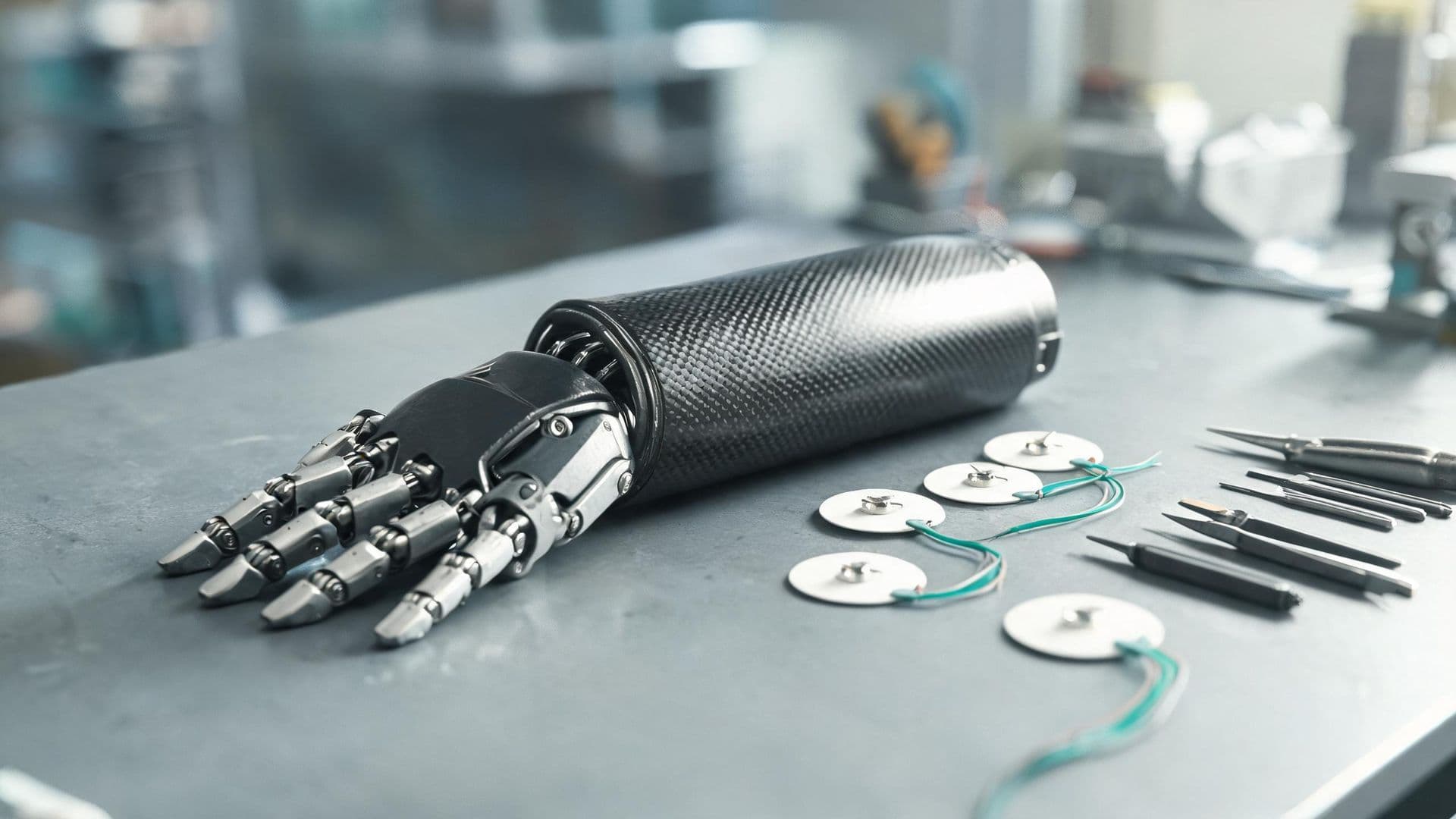 Illustrative image
The challenge
A prosthetics research institute needed to develop an affordable, high-performance prosthetic arm that could interpret muscle signals naturally, learn user-specific patterns, and provide intuitive control - making advanced bionic limbs accessible to amputees in developing countries.
Prohibitive costs
Commercial myoelectric arms cost several times the client's target price, putting them out of reach for most amputees worldwide. An affordable solution was critical.
Signal interpretation
EMG signals are noisy, vary between users, and change with electrode placement. Reliable gesture recognition required advanced signal processing.
Natural movement
Users need intuitive control without conscious effort. The system had to learn individual muscle patterns and respond instantly.
Durability & practicality
The prosthetic needed all-day battery life, water resistance, and durability for daily activities while remaining lightweight.
Impact figures describe the situation before the project, as the client reported it to us; we did not measure them.
Our solution
We developed a complete EMG-controlled prosthetic arm system featuring custom EMG acquisition hardware, real-time signal processing, machine learning-based gesture recognition, and a mechanically efficient robotic hand with 6 actuated degrees of freedom and 16 gesture positions.
System architecture
End-to-end bionic arm system from muscle signal to mechanical movement.
EMG acquisition
- 8-channel surface EMG electrodes
- 24-bit ADC with 2000 Hz sampling
- Active noise cancellation circuitry
- Flexible electrode array interface
- Impedance monitoring for contact quality
Signal processing & ML
- Real-time feature extraction (MAV, RMS, WL)
- Adaptive noise filtering
- CNN + LSTM gesture classifier
- User-specific model adaptation
- Continuous learning from usage
Robotic hand
- 6 DOF hand with 16 gesture positions
- Brushless DC motors with encoders
- Force feedback sensors in fingertips
- Proportional grip strength control
- Quick-release wrist connector
Custom hardware design
- EMG Channels
- 8 differential channels
- ADC Resolution
- 24-bit, 2000 SPS
- MCU
- STM32H7 (480 MHz, DSP)
- ML Accelerator
- Coral Edge TPU
- Motors
- 6x BLDC with planetary gears
- Battery
- 2000mAh Li-Poly (12hr life)
- Hand Weight
- 380g (below elbow)
- Grip Force
- 45N (proportional control)
Real-time firmware architecture
- Dual-core processing (signal + motor control)
- 1ms control loop for motor position
- Edge ML inference at 50 Hz
- Proportional-derivative force control
- Haptic feedback via vibration motors
- Safety limits and error detection
- Battery management with 12hr life
Implementation timeline
Phase 1: Research & requirements
8 weeks- Literature review of myoelectric control
- User research with amputee community
- EMG signal characterization studies
- Gesture set definition with clinicians
Phase 2: EMG hardware development
12 weeks- Low-noise analog front-end design
- Electrode array optimization
- PCB design and EMC pre-compliance testing
- Signal quality validation
Phase 3: ML model development
16 weeks- Training data collection (50 subjects)
- CNN + LSTM architecture development
- Real-time inference optimization
- User adaptation algorithms
Phase 4: Robotic hand development
14 weeks- Mechanical design and simulation
- Motor selection and gear optimization
- 3D-printed prototypes
- Force control implementation
Phase 5: Integration & testing
12 weeks- System integration
- Early user trials
- Performance optimization
- User experience refinement
Phase 6: DFM & certification preparation
10 weeks- Design for manufacturing
- Design documentation structured for the client's quality system
- CE marking preparation
Results & impact
The robotic prosthetic arm was engineered to a $10,000 target price, a fraction of the cost of commercial myoelectric arms, with bench testing and early user trials informing the gesture-recognition and control design. Accuracy and latency were bench-tested; cost, calibration time and battery life are design targets.
How to read the labels: Bench-tested = measured in bench or lab testing; Design target = an engineering target, not a field measurement; Client-reported baseline = the client's own figure for the situation before the project; we did not measure it. Figures without a label are specifications or project scope.
Gesture accuracy
Bench-tested94%
Across 16 gesture classes
Response latency
Bench-tested< 100ms
EMG to movement
Calibration time
Design target10 min
For new user setup
Battery life
Design target12 hours
Full day operation
Target price
Design target$10,000
Unit price target set by the client
Technologies used
- STM32H7
- Coral Edge TPU
- TensorFlow Lite
- EMG Sensors
- BLDC Motors
- Force Sensing Resistors
- Python
- C++
- CAD/FEA
Related case studies
Healthcare / Medical Devices
Medical wearable: Remote patient monitoring device for cardiac care
Logistics / Warehousing / Robotics