5G, Bluetooth 6.0 & Wireless Tech
5G RedCap for IoT: Design Guide & Hardware Specs

- IoT Devices
- Low-Power MCU
- Wireless Connectivity
- +1 more
Contents· 9 sections
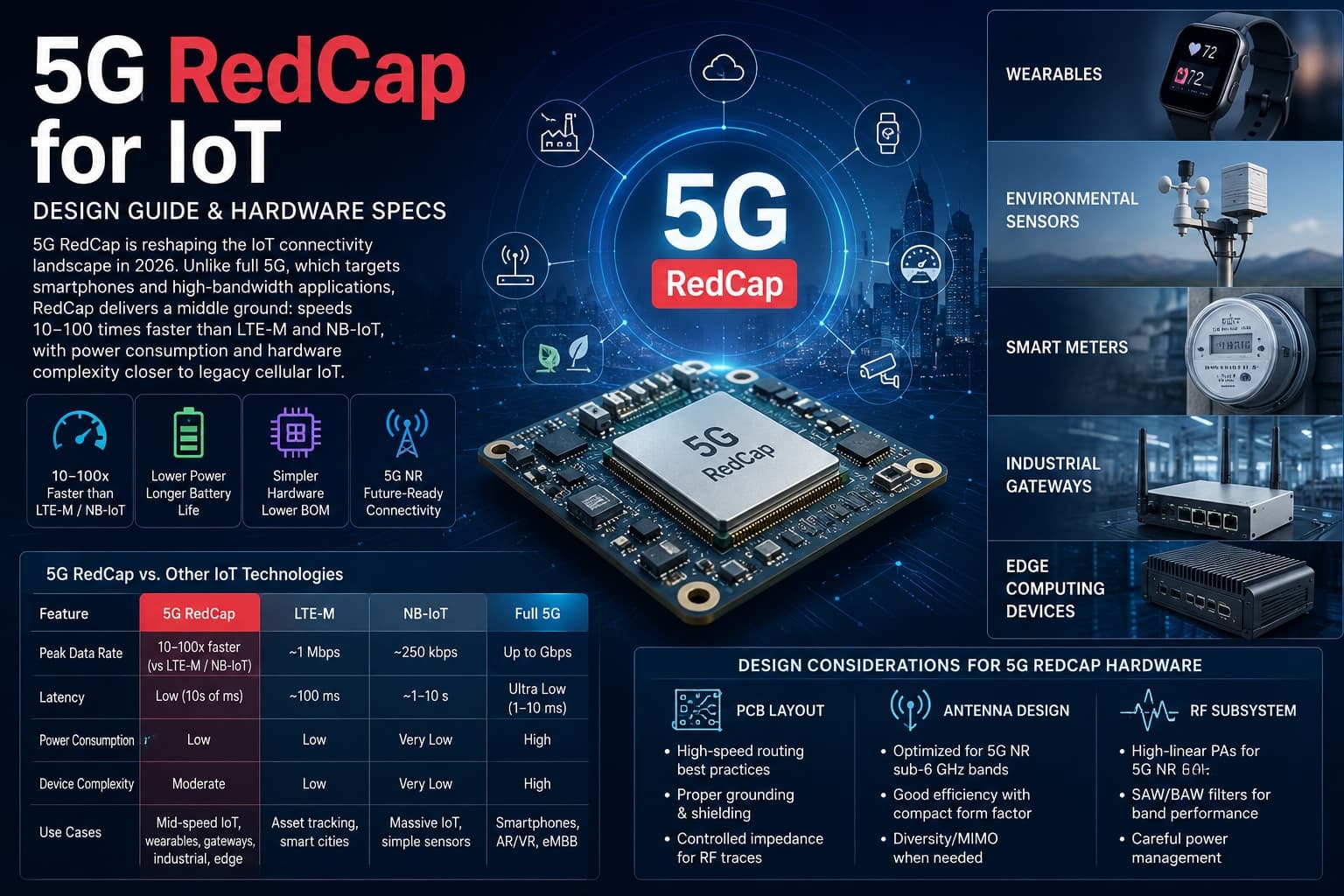
5G RedCap is reshaping the IoT connectivity landscape in 2026. Unlike full 5G, which targets smartphones and high-bandwidth applications, RedCap delivers a middle ground: speeds 10–100 times faster than LTE-M and NB-IoT, with power consumption and hardware complexity closer to legacy cellular IoT. Hardware teams designing wearables, environmental sensors, smart meters, industrial gateways, and edge computing devices need to understand when RedCap makes sense — and how to adapt PCB layouts, antenna designs, and RF subsystems to suit it.
Key Takeaways
- 5G RedCap reaches up to ~150 Mbps downlink with 2 receive antennas (roughly half with a single Rx) and ~50 Mbps uplink, well above LTE-M (1–4 Mbps) and NB-IoT (0.25 Mbps), bridging the speed gap between cellular IoT and full 5G.
- Power consumption is 60–70% lower than 5G eMBB, thanks to single-antenna designs, simplified modulation, and reduced compute overhead.
- Latency typically lands under 100 ms, suitable for near-real-time applications like remote diagnostics, telemedicine wearables, and vehicle telemetry.
- Major carriers (T-Mobile, Verizon, AT&T, Telefonica, Deutsche Telekom, SoftBank, M1) have rolled out or committed to national RedCap coverage in 2026.
- Silicon options include Qualcomm Snapdragon X35, MediaTek Dimensity with UltraSave, Sequans eRedCap Gen-3, and Quectel modules (RG255C, RG255G).
- PCB and antenna design differs from full 5G: a single receive antenna (1 Rx; 2 Rx optional) replaces 4-antenna MIMO, matching tolerances relax, and ground plane geometry becomes more forgiving.
What is 5G RedCap?
5G RedCap is a simplified flavor of 5G NR (New Radio), standardized in 3GPP Release 17 and refined in Release 18. The “reduced capability” label refers to dropped features, not inferior performance in the domains that matter for IoT.
RedCap omits beamforming, dual-antenna MIMO above Release 17, and the high-complexity channel equalization required for mmWave. In exchange, devices drop from ~10 W typical draw to 1–2 W for continuous use, matching LTE-M and NB-IoT on power-per-gigabyte and often beating them on actual energy per transaction because the data transfer finishes 50–100 times faster.
The standard targets devices that sit between legacy cellular IoT and flagship 5G handsets. Industrial IoT gateways, security cameras with cloud backup, connected health monitors, and smart agriculture hubs all fit. They need faster uploads than NB-IoT can deliver but cannot afford the 5–10 W continuous draw of full 5G modems.
RedCap vs LTE-M vs NB-IoT vs Full 5G: A Hardware Comparison
| Parameter | 5G RedCap | LTE-M | NB-IoT | 5G eMBB |
|---|---|---|---|---|
| Peak DL Rate | ~150 Mbps (2 Rx); ~85 Mbps (1 Rx) | 4 Mbps | 0.25 Mbps | 1+ Gbps |
| Peak UL Rate | 50 Mbps | 1 Mbps | 0.06 Mbps | 500+ Mbps |
| Typical Latency | <100 ms | 50–200 ms | 1–10 s | 10–40 ms |
| Continuous Power Draw | 1–2 W | 0.3–1 W | 0.1–0.3 W | 5–10 W |
| Antenna Config | 1 Rx (2 Rx optional) | Single | Single | Dual+ MIMO |
| Bandwidth | 20 MHz | 1.4 MHz (Cat-M1) / 5 MHz (Cat-M2) | 200 kHz | 20–400 MHz |
| Modulation (Peak) | 64-QAM | 64-QAM | QPSK | 256-QAM |
| Typical Use Case | Real-time monitoring, video, edge compute | Occasional uploads, tracking | Ultra-low-power sensors | Mobile broadband, AR |
| Sample Module | Quectel RG255C (Snapdragon X35) | Quectel BG95/BG77, u-blox SARA-R510 | Quectel BC95 | Snapdragon X80 |
Key insight: RedCap trades absolute latency and data rate against LTE-M, but rarely against 5G eMBB. The real value is bulk data transfer. A 10 MB sensor log that takes 40 seconds over LTE-M or 7 minutes over NB-IoT takes 1–2 seconds over RedCap, cutting device wake time and power drain by orders of magnitude.
Hardware and PCB Implications
Single-Antenna RF Subsystem
RedCap devices can use a single receive antenna (1 Rx, with 2 Rx optional) at Release 17, simplifying RF frontend design versus the dual-antenna MIMO arrays in full 5G. This cuts BOM cost by removing a second RF cable, antenna, and duplexer bank. PCB routing complexity drops because trace impedance tolerance and length matching rules relax slightly. Form factor pressure eases, since single-antenna designs fit smaller enclosures.
Most RedCap module and SoC vendors (Qualcomm, MediaTek, Sequans) ship matching networks and reference designs for 50 Ω single-antenna feeds. Unlike full 5G, where antenna selection demands careful consideration, RedCap teams often reuse proven LTE-M or Cat-1bis antenna designs with minor impedance tuning.
Impedance should hold ±5 Ω at the module interface. PCB trace width and layer stackup follow standard 50 Ω microstrip or stripline geometry; for IoT PCB designs, 0.2–0.4 mm trace width is typical depending on layer and dielectric constant.
Ground Plane and Return Path Design
Single-antenna designs allow more flexibility in ground plane topology. Full 5G MIMO chains require pristine ground continuity to avoid phase ripple; RedCap is more forgiving. Cleanliness still matters:
- Ground plane should be continuous under RF traces (no splits or notches unless crossing layers through a stitching via).
- Return paths to the antenna pad should avoid 90° angles; 45° bends reduce EMI and impedance discontinuity.
- Via stitching around the RF zone is recommended at 1–2 mm spacing.
For devices running both cellular and GNSS, separate antenna feeds are typical. RedCap modems integrate receiver-only paths for assisted-GPS or position-assist functions; use a low-loss duplexer to merge UHF/L-band signals if the PCB space allows, or separate connectors if space is tight.
Component Selection and Matching
RedCap modules (Quectel RG255C, RG255G) ship with integrated RF frontends — power amplifiers, low-noise amplifiers, filters, and duplexers on-chip or in the module. Host PCB design is therefore lighter:
- Decoupling: standard ceramic caps (0.1 µF to 10 µF) on supply rails per modem datasheet. Most modules want 47 µF bulk caps on each supply rail (3.3 V, VBUS).
- Filtering: IF and baseband signals are pre-filtered inside the module. No extra SAW filters needed on the host board in most cases.
- Clock distribution: RedCap modems need a precise reference clock (typically 26 MHz or 32.768 MHz crystal). Host clock distribution should use shielded traces or buried routing to minimize jitter; the reference oscillator (usually inside the module) sets frequency accuracy, so keep noisy rails and switching nodes away from it.
Thermal Considerations
RedCap’s 1–2 W continuous draw is modest, but burst transmit can hit 4–5 W. Modules like the Quectel RG255C have integrated power management, but the host PCB should still provide:
- Copper pour under the module for passive heat dissipation.
- Via thermal stitching from the module thermal pad through 2–3 layers to the back copper, if the module has a large exposed pad.
- No heatsink or active cooling is usually required for IoT duty cycles (transmit < 10% of the time); passive spreading is sufficient.
Antenna Design for RedCap
Most hardware teams will start with a proven LTE-M antenna and validate impedance match on a test board. RedCap antenna requirements are permissive:
- VSWR < 2:1 across the allocated bands (FR1 bands from 600 MHz (n71) to 3.8 GHz (n77/n78), depending on operator).
- Gain: 2–4 dBi typical for a compact monopole or inverted-F antenna (IFA); full 5G expects 4–8 dBi from phased arrays.
- Radiation pattern: omnidirectional or near-omnidirectional. Polarization mismatch is acceptable within ±3 dB.
- Physical size: 15–25 mm monopole or PCB-mounted patch antenna for portable devices; larger form factors can use external antennas.
LTE-M planar monopole or IFA topologies translate to RedCap with the same EM simulation tools and measurement practices (VNA, anechoic chamber for pattern). The main delta is frequency: antenna element dimensions scale roughly inversely with frequency, while the 50 Ω feed geometry does not change.
When to Choose RedCap Over the Alternatives
Choose RedCap if:
- Data volume or transfer frequency is high: video uploads, high-resolution logs, firmware updates, frequent cloud syncs.
- Latency or responsiveness is critical: remote control, telemedicine, vehicle backhaul.
- Device has moderate power budget: 2000 mAh or larger battery, or AC mains, allowing 1–2 W continuous draw.
- Regional carrier rollout is mature in your target market.
Stick with LTE-M if:
- Occasional cloud uploads are the only use case (geolocation every hour, heartbeat messages).
- Battery life must exceed 5 years on a small coin cell.
- Network coverage is sparse: LTE-M is mature globally; RedCap rollout is ongoing.
Stick with NB-IoT if:
- Device wakes once per day or less (smart meters, environmental sensors, asset trackers).
- Cost per modem is paramount (NB-IoT modules are commodity priced).
- Building penetration is critical: NB-IoT’s lower frequency gives it an edge in deep indoor deployments.
Common Questions About 5G RedCap
How much faster is RedCap than LTE-M for real-world applications?
Peak speed is 30–150 Mbps depending on signal quality and spectrum sharing. For a 10 MB file, LTE-M takes 40 seconds; RedCap completes in 1–3 seconds. In practice, RedCap cuts transmit energy by around 90% on bulk transfers because the modem idles faster and the radio tail (the time before sleep resumes) is much shorter.
Can I reuse my existing LTE-M PCB design for RedCap?
Mostly yes, with caveats. Antenna impedance tuning, component placement around the modem, and clock distribution remain similar. You must validate that your antenna matches the RedCap bands your operator uses (FR1 bands from 600 MHz to 3.8 GHz) and that your power supply can sustain 4–5 W bursts without sagging below the modem’s minimum rail (cellular module VBAT is typically 3.3–4.4 V, nominal 3.8 V). Many LTE-M designs need a 100–200 µF bulk cap addition to smooth burst load. VNA antenna validation is mandatory.
Which RedCap standard version should I design for?
3GPP Release 17 is the baseline. Release 18 (frozen 2024) adds eRedCap, which cuts complexity further — about 5 MHz baseband bandwidth and ~10 Mbps peak — for wearables and sensors; Release 17 RedCap remains the mainstream target for 2026 designs.
What’s the latency penalty if I choose a remote antenna?
Cable loss is the main penalty. A 2–3 meter RG-174 cable from module to remote antenna introduces ~2–3 dB loss, reducing link budget by that margin. In typical urban 5G coverage, this means 5–10% data rate loss; in marginal signal areas, it can be 30–50%. If a remote antenna is required, use low-loss cable (RG-316, 50 Ω impedance) and minimize length.
How do I ensure RedCap interoperability across regions?
RedCap spectrum varies by operator: India uses n78 and n28; the US uses n71, n41 and n77; Europe commonly n78, n28 and refarmed 1.8/2.1 GHz bands. Multi-band modules (Quectel RG255C-GL) cover most major geographies in a single SKU using software-defined tuning. For global designs, confirm your chosen modem covers the target regions and order the regional variant. The global SKU is useful for R&D; production often uses region-locked versions to simplify certification.
Do I need 5G SA (Standalone) or can I use NSA (Non-Standalone)?
RedCap is defined for 5G NR in both SA and NSA modes. SA is preferred for new devices because it removes dependency on legacy LTE infrastructure and enables cleaner network slicing. NSA operation is allowed and is sufficient if your target carrier network is NSA-first. Most 2026 carrier rollouts favor SA.
Working With Rapid Circuitry on RedCap Designs
5G RedCap fills a real gap between legacy cellular IoT and full 5G. For hardware teams, that means simpler RF design, reasonable power budgets, and meaningful speed improvements. Antenna and PCB design can reuse much of the LTE-M and Cat-1bis playbook, with validation for mid-band 5G frequencies and burst power delivery.
The decision hinges on your application’s data volume, latency tolerance, battery endurance, and carrier footprint. If you ship devices with gigabyte-scale data per month or sub-100 ms latency requirements, RedCap is the right tool.
If you’re evaluating RedCap modems or need an RF design partner that has shipped LTE-M, NB-IoT, and 5G NR boards, get in touch with Rapid Circuitry. We work on multi-band antenna validation, impedance tuning, and PCB layout for cellular IoT regularly, and we’re happy to walk through your hardware roadmap.
References
Still researching? Read our free How to Choose a Microcontroller (MCU).
Related engineering services
Get new articles by email
New guides and engineering articles on PCB design, firmware and IoT, in your inbox.